
Atriale Fibrillasie, algemeense hartritme-defek met nuwe tegnologie behandel
Die eerste geval in Afrika waar ’n pasiënt met revolusionêre nuwe tegnologie behandel is om ‘n hartritme-defek te herstel, is Maandag in die Kaapse Skiereiland gedoen.
Die nuwe tegnologie bekend as elektro-porasie is uiters nuut, maar baie opwindend en kan moontlik tot ’n omwenteling in die behandeling van nie net atriale fibrillasie nie, maar alle ander hartritme-defekte lei.
Die eerste pasiënt, mnr Robert Reynecke (59) van Proteavallei, het kort na die prosedure, geglimlag. Geen teken van die hartritme-defek is sigbaar nie en kon selfs nie eens met verskeie probeerslae in die teater weer opgewek word nie.

Mnr Reynecke se hart-ritme is nou normale sinus-ritme, het Dr Razeen Gopal, hartritme-spesialis van die Cape Town AF Center by die Panorama Mediclinic in die Kaapse Skiereiland, gesê.
Die nuwe tegnologie, bekend as pulsveld-ablasie (of elektro-porasie), is baie nuut. Hoewel dit al in Europa, Engeland en die Midde-Ooste beskikbaar is, is dit nou in Suid-Afrika beskikbaar vóórdat dit in Amerika of Kanada beskikbaar is.
Volgens Prof Nico Reinsch, hartritme-spesialis van Essen in Duitsland, onder wie se toesig die eerste reeks van dié nuwe behandelings vandeesweek gedoen word, kan elektroporasie beskryf word as revolusionêr en nie bloot evolusionêr nie.

In die tagtigerjare het hartspesialiste probeer om hartritme-defekte met direkte elektriese ladings te behandel, maar die ladings was te moeilik beheerbaar, nie akkuraat genoeg nie en het groot skade aan omliggende hart- en ander weefsel veroorsaak. Dit is gestaak. Nou is die lewering van direkte elektriese ladings aan selle dramatiese verfyn tot die nuwe tegniek.
Elektro-porasie is anders as enige vorige ablasie-tegnieke, soos hitte (ook bekend as radio-frekwensie) of yskoue (krio-ballon), wat tot dusver gebruik is om atriale fibrillasie te behandel.
Met die nuwe tegnologie, wat ook per hartkateter via die femorale aar in die lies tot in die hart geplaas word en dan deur die septum na die linker atrium gestoot word, word vinnige, beheerde elektriese pulse binne mikrosekondes op die regte plekke afgevuur. Die elektriese ladings word deur die toestel aan die voorpunt van die kateter vrygestel. Die toestelletjie ontplooi eers halfpad soos ’n mandjie en dan soos ’n blommetjie met vyf kroonblare.


Die spesifieke frekwensie wat ingespan word, skiet mikro-porieë in die selmembrane wat daartoe lei dat die spesifieke selle waarop die ‘skote’ gemik is, sterf terwyl geen omliggende weefsel beskadig word nie. Geen omliggende weefsel word beskadig nie, omdat hartweefsel die gevoeligste is vir die lading en frekwensie van die elektriese skote, terwyl ander weefsel se drempelwaardes vir skade hoër is. As dit nie die geval was nie, was elektroporasie nie moontlik nie, het prof. Reinsch verduidelik.
Die voordele van die nuwe tegnologie is dat dit baie vinnig is – die ablasie self duur in ervare en kundige hande skaars ‘n minuut – en dat dit doeltreffend is om atriale fibrillasie toeltreffend te behandel. Voorts is dit veiliger as enige ander tegnologie omdat die frekwensie van die pulse so laag en spesifiek is dat dit slegs die hartselle waarop dit gemik word, laat sterf, maar geen ander weefsel nie, het dr Gopal gesê.

Hoewel die nuwe tegnologie nog baie nuut is, het die studies wat sedert 2018 gedoen word, uiters belowende resultate getoon, en lewer die sentra in Europa en Engeland waar die elektroporasie nou ingespan word, dieselfde goeie resultate as in die studies.
“Ek is baie hoopvol dat hierdie nuwe tegnologie inderdaad die tegnologie van die toekoms gaan word, en dat alle gevalle van atriale fibrillasie wat met ablasie behandel kan word, binne ’n jaar of twee met elektroporasie behandel sal word.’’
Dr Gopal voorsien dat die nuwe tegnologie in die toekoms ook ingespan sal word om alle ander hartritme-defekte soos Wolf-Parkinson-White sindroom in kinders te behandel, want navorsing is reeds aan die gang om die toestelletjie waardeur die elektriese stroom die hartweefsel raak, te verander in ’n fokus-toestelletjie wat foutiewe weefsel puntsgewys kan vernietig.
Latest News:

Eerste in Afrika
Atriale Fibrillasie, algemeense hartritme-defek met nuwe tegnologie behandel Die eerste geval in Afrika waar ’n pasiënt met revolusionêre nuwe tegnologie behandel is om ‘n hartritme-defek te herstel, is Maandag in die Kaapse Skiereiland gedoen. Die nuwe tegnologie bekend as elektro-porasie is uiters nuut, maar baie opwindend en kan moontlik tot ’n omwenteling in die behandeling […]

Watch our recent Masterclass Sessions in Cardiology
Sessions by renowned international cardiology experts Introduction and Welcome: Dr Razeen Gopal, electrophysiologist and director of the Cape Town AF Center. 2. Renal denervation in dthe managent of resistant hypertension: Dr Riaz Dawood, Lenmed Clinic. 3. Complex percutaneous coronary intervention (PCI) for high bleeding risk patients: Prof Ivo Petrov, Univerity of Sofia, Bulgaria. 4. TAVI/Percutaneous […]

Treatment with most advanced therapy for management of atrial fibrillation will change a teenager’s life today
Today an 18-year-old boy with atrial fibrillation (AF) has become the first patient in Africa and the Middle East to be treated with the latest and most advanced therapy available in the management of atrial fibrillation. According to Dr Razeen Gopal, renowned cardiologist and electrophysiologist at the Cape Town AF Centre (CTAFC) based at Mediclinic […]

Why conduction system pacing is the most synchronized physiological pacing modality of the future?
In a nutshell: Patients with a bradycardia (slow heart rate) or conduction system disease, can now be paced more effectively with a procedure referred to as His Bundle Pacing (HBP). The conduction system is stimulated directly, allowing both ventricles to contract simultaneously. This leads to better patient outcomes, and bypasses the risk of developing left […]

Skrik wakker; slaap-apnee beskadig jou hart
Wat het slaap-apnee en snork met jou hart te doen? Baie meer as wat jy ooit kon droom. As jy of jou maat aan snags ophou asemhaal en dan weer skielik na asem snak, MOET jy eenvoudig na dié program luister. Onbehandelde slaap-apnee met hartprobleme kan jou lewe met 20 jaar verkort. Sowat 1 uit […]

Ventricular arrhythmias: New solutions for deadly heart conditions
The first emerging market regions implantation of the world’s smallest smart device to control heart beats and pumping action was performed yesterday by Dr Gopal and his team at the Cape Town AF Centre, Panorama hospital, Cape Town. These devices, known as Implantable cardioverter-defibrillators (ICD), are increasingly being used worldwide and also in developing countries, […]

Nuwe, gevorderde Hisbondel-pasaangeërs laat selfs swak harte sterker klop
Nuwe, gevorderde pasgeër-inplantingsprosedure wat selfs verswakte hart sterker laat klop, is nou in Kaapstad beskikbaar ‘n Té stadige hartklop, is algemeen in ouer mense en is gewoonlik die gevolg van ‘n blokkasie in die hart se spesiale elektriese geleidingsweefsel, soms ná ‘n hartaanval. Nou het medici ‘n manier gevind om die geleidingsweefsel van die hart […]
The Cape Town AF centre is based within the Panorama Mediclinic heart unit which is a private hospital that offers a flexible and speedy service to our insured patients. For patients currently uninsured a special tariff can be negotiated.
The Cape Town AF Centre is different
At the Cape Town AF Centre we believe in the importance of a team approach. The team is built around heart specialists who are both colleagues and friends. We share our experience, consult with each other and will often operate together. Patients are therefore never without help even if their own consultant is away for example on holiday. Our cardiologists have a vast experience between them.
Sessions by renowned international cardiology experts
- Introduction and Welcome: Dr Razeen Gopal, electrophysiologist and director of the Cape Town AF Center.
2. Renal denervation in dthe managent of resistant hypertension: Dr Riaz Dawood, Lenmed Clinic.
3. Complex percutaneous coronary intervention (PCI) for high bleeding risk patients: Prof Ivo Petrov, Univerity of Sofia, Bulgaria.
4. TAVI/Percutaneous valves – An update for 2021: Dr Adriaan Horak, cardiologist, Vincent Pallotti Hospital
5. Ablation for Artrial Fibrillation (AF) – The critical importance of early intervention: Prof Richard Schilling, St Bartholomews, London, UK.
6. An update on the European Heart Rhythm Association (EHRA) – Practical novel oral anti-coagulants (NOAC) use guide: Prof Jan Steffel, University Hospital Zurich, Switzerland
7. Judicious use of antiarrhythmic drugs and ablation in the management of AF and heart failure: Prof Timothy Betts, Oxford University Hospital, NHS Foundation Trust, UK
8. Stroke and Atrial Fibrillation (AF) – make the LINQ: Prof Helmut Purerfellner, Ordensklinikum Linz, Austria
9. Applied anatomy for the interventional cardiologist and electrophysiologist: Prof Maxim Didenko, Kirov Military Medical Academy, Russia.
10. Conduction system pacing – State of the art – the future is here: Dr Pugazhendhi Vijayaraman, Geisinger Heart Institute, USA
11. Device therapy and automic modulation in heart failure: Prof Michael R Gold, Medical University of South Carolina, USA.
12. An appraisal of the 2021 heart failure and pacing guidelines: Dr Muzahir Tayebjee, Leeds Teaching Hospital, NHS Trust, UK.
13. Ethics: Doctors in the resource constraint environment: Elsabé Klinck, South Africa
14. Wrap Up: Dr Razeen Gopal
Latest News:
Eerste in Afrika
Atriale Fibrillasie, algemeense hartritme-defek met nuwe tegnologie behandel Die eerste geval in Afrika waar ’n pasiënt met revolusionêre nuwe tegnologie behandel is om ‘n hartritme-defek te herstel, is Maandag in die Kaapse Skiereiland gedoen. Die nuwe tegnologie bekend as elektro-porasie is uiters nuut, maar baie opwindend en kan moontlik tot ’n omwenteling in die behandeling […]
Watch our recent Masterclass Sessions in Cardiology
Sessions by renowned international cardiology experts Introduction and Welcome: Dr Razeen Gopal, electrophysiologist and director of the Cape Town AF Center. 2. Renal denervation in dthe managent of resistant hypertension: Dr Riaz Dawood, Lenmed Clinic. 3. Complex percutaneous coronary intervention (PCI) for high bleeding risk patients: Prof Ivo Petrov, Univerity of Sofia, Bulgaria. 4. TAVI/Percutaneous […]
Treatment with most advanced therapy for management of atrial fibrillation will change a teenager’s life today
Today an 18-year-old boy with atrial fibrillation (AF) has become the first patient in Africa and the Middle East to be treated with the latest and most advanced therapy available in the management of atrial fibrillation. According to Dr Razeen Gopal, renowned cardiologist and electrophysiologist at the Cape Town AF Centre (CTAFC) based at Mediclinic […]
Why conduction system pacing is the most synchronized physiological pacing modality of the future?
In a nutshell: Patients with a bradycardia (slow heart rate) or conduction system disease, can now be paced more effectively with a procedure referred to as His Bundle Pacing (HBP). The conduction system is stimulated directly, allowing both ventricles to contract simultaneously. This leads to better patient outcomes, and bypasses the risk of developing left […]
Skrik wakker; slaap-apnee beskadig jou hart
Wat het slaap-apnee en snork met jou hart te doen? Baie meer as wat jy ooit kon droom. As jy of jou maat aan snags ophou asemhaal en dan weer skielik na asem snak, MOET jy eenvoudig na dié program luister. Onbehandelde slaap-apnee met hartprobleme kan jou lewe met 20 jaar verkort. Sowat 1 uit […]
Ventricular arrhythmias: New solutions for deadly heart conditions
The first emerging market regions implantation of the world’s smallest smart device to control heart beats and pumping action was performed yesterday by Dr Gopal and his team at the Cape Town AF Centre, Panorama hospital, Cape Town. These devices, known as Implantable cardioverter-defibrillators (ICD), are increasingly being used worldwide and also in developing countries, […]
Nuwe, gevorderde Hisbondel-pasaangeërs laat selfs swak harte sterker klop
Nuwe, gevorderde pasgeër-inplantingsprosedure wat selfs verswakte hart sterker laat klop, is nou in Kaapstad beskikbaar ‘n Té stadige hartklop, is algemeen in ouer mense en is gewoonlik die gevolg van ‘n blokkasie in die hart se spesiale elektriese geleidingsweefsel, soms ná ‘n hartaanval. Nou het medici ‘n manier gevind om die geleidingsweefsel van die hart […]
The Cape Town AF centre is based within the Panorama Mediclinic heart unit which is a private hospital that offers a flexible and speedy service to our insured patients. For patients currently uninsured a special tariff can be negotiated.
The Cape Town AF Centre is different
At the Cape Town AF Centre we believe in the importance of a team approach. The team is built around heart specialists who are both colleagues and friends. We share our experience, consult with each other and will often operate together. Patients are therefore never without help even if their own consultant is away for example on holiday. Our cardiologists have a vast experience between them.
Today an 18-year-old boy with atrial fibrillation (AF) has become the first patient in Africa and the Middle East to be treated with the latest and most advanced therapy available in the management of atrial fibrillation.
According to Dr Razeen Gopal, renowned cardiologist and electrophysiologist at the Cape Town AF Centre (CTAFC) based at Mediclinic Panorama, ablation therapy is the most effective manner to treat atrial fibrillation especially of recent onset or of short duration. AF is described as a ‘chaotic heart rhythm’ and remains a common cause of stroke. Cryo-ablation is at least as effective, if not superior to thermal energy (radio- frequency) ablation. Current literature has consistently confirmed that balloon-based procedures for atrial fibrillation such as cryo-ablation, are considerably safer than radio-frequency based ablation procedures, with a markedly reduced chance of cardiac perforation.” I would imagine this latest cryo-balloon technology now offers us an even safer option” Dr. Gopal explained.

Christopher Groenewald (18), was diagnosed with AF after experiencing heart palpitations since his 12th year. He became the 1st patient in the Emerging World (Africa and the Middle East) to undergo cryo-ablation with the new POLARx system. Christopher was discharged two days after the procedure and will soon enroll at UCT to study engineering.
Christopher Groenewald was diagnosed with symptomatic longstanding persistent atrial fibrillation, with severely compromised quality of life. His AF has proved to be most debilitating, causing recurrent palpitations, dizziness and fatigue. He was accepted for Dr. Gopal’s cryo-ablation programme once an implantable loop recorder (a small recording device, the size of a matchstick injected just below skin), confirmed the absence of simpler cardiac rhythms, serving as catalysts or triggers for his AF.
“All our team wants to do is change lives by giving patients back the type of lifestyle quality they were previously able to enjoy,” Dr Gopal said.
“I feel quite privileged that our centre has been chosen to showcase this latest innovation confirming our status as one of the leading centres in the region (Middle East and Africa” Dr Gopal said.
The technology used was the POLARx device introduced by industry leader Boston Scientific.
[Watch Animation of POLARx cryo-ablation here: https://www.youtube.com/watch?v=ala9cVG0yFI&feature=youtu.be]
With the latest technology, an experienced electrophysiologist can change the life of a person with a minimally invasive procedure generally lasting under an hour.
The new POLARx cryo-ablation system has been designed and built from the ground up to retain the best of an established approach and performance of cryo-ablation with additional expert-driven changes for an improved experience in the ablation procedure.
The introduction of the re-engineered therapy will be incorporated into treatment options going forward so as to give comprehensive and patient-centric options for the best treatment outcomes.
Further notes
Notes on Atrial Fibrillation
Atrial Fibrillation (or AF) is the most common heart rhythm disorder and affects one in eight people over the age of 60 years, but increasingly also affects younger people. Its incidence usually increases with age.
AF is an irregular heart rhythm that affects the upper chambers (atriae) of the heart. Due to extra electrical signals entering particularly the left upper chamber, the atriae may contract at a fast or slow rate but with an always irregular and chaotic rhythm. This quivering form of contractile dysfunction, instead of normal synchronous beating, may result in the turbulent flow of blood in these upper chambers, leading to pooling and clotting due to the slow flow, and resulting in catastrophic stroke.
Treating AF is important because:
Untreated AF leads to an elevated (up to 5 – 10 times higher) risk of stroke, since a blood clot from the atriae may lodge in the brain. This risk is elevated particularly in people with a history of stroke, diabetes, hypertension or those older than 65 years;
If the irregular heart rhythm continues on a permanent basis in a rapid and uncontrolled fashion (known as persistent AF) it can lead to heart failure, since the pumping chambers (ventricles) cannot contract effectively at a sustained rapid rate.
Untreated AF may eventually lead to changes in the heart’s electrical architecture, resulting in worsening of irregular heart rhythms.
AF is associated with symptoms of fatigue, shortness of breath, listlessness, palpitations, chest discomfort, dizziness and fainting, and deleteriously affects quality of life.
More about cryo-ablation
How it works
Cryo-ablation makes use of extremely low temperature (intense cold energy) to eliminate the effect of malfunctioning cells that spark additional electrical signals. The heart’s rhythm and rate can therefore not be regulated.
Two catheters are inserted through the groin and into the femoral veins, which are then pushed up into the right atrium of the heart. They are positioned in the left atrium through a small hole made in the septum, a membrane separating the two chambers. A cryo-balloon is inserted at the base of one of the four pulmonary veins, inflated and cooled. This creates a contiguous ring of strategically damaged heart tissue, which effectively blocks faulty signals. The process is then repeated on the other three pulmonary veins entering the left atrium.
Cryo-ablation has revolutionised the early treatment of atrial fibrillation and is now used universally in the management of both paroxysmal and persistent AF. The Consensus Statement of the European Cardiac Society state in their guidelines that cryo-ablation may be used as first line therapy for the management of symptomatic, intermittent (in particularly new onset) as well as persistent (longstanding) atrial fibrillation.
High success rate; Less complications
The technology has the added advantage of hardly, if ever, causing additional rhythm disturbances as a consequence of lesion formation, as in the case of radio-frequency ablation.
Dr Gopal notes that this has been a major step forward as these post-ablation arrhythmias related to scarring, from heat energy, may be the bane of existence of any electrophysiologist, often being very difficult to localize and cure. In the interim newer generations of anti-clotting medications also have emerged in the battle against stroke.
Currently, studies have shown, that early ablation treatment leads to better long-term results and improved quality of life. Dr. Gopal emphasises that the earlier patients are referred in the course of their disease the better the outcome of the therapy.
In the hands of an experienced and competent electrophysiologist the risk for complications is extremely low for either cryo-ablation or radio-frequency ablation
Approximately 90% of patients with paroxysmal (intermittent) AF stop taking anti-arrhythmia medication (while anti-clotting drugs may remain lifelong depending on stroke risk) within a year post-procedure. In longstanding persistent atrial fibrillation approximately 75% of patients recover from AF after two or three ablations sets. The management strategy at CTAFC has always been to solely use cryo-ablation for pulmonary vein isolation, and to consider RF ablation to perform linear substate modification, only in persistent patients, who have failed the initial therapy. A minority of individuals may need to remain on medications to assist in control of their arrhythmia. Success rates achieved at Dr Gopal’s unit compare well with the very best internationally.
Latest News:
Eerste in Afrika
Atriale Fibrillasie, algemeense hartritme-defek met nuwe tegnologie behandel Die eerste geval in Afrika waar ’n pasiënt met revolusionêre nuwe tegnologie behandel is om ‘n hartritme-defek te herstel, is Maandag in die Kaapse Skiereiland gedoen. Die nuwe tegnologie bekend as elektro-porasie is uiters nuut, maar baie opwindend en kan moontlik tot ’n omwenteling in die behandeling […]
Watch our recent Masterclass Sessions in Cardiology
Sessions by renowned international cardiology experts Introduction and Welcome: Dr Razeen Gopal, electrophysiologist and director of the Cape Town AF Center. 2. Renal denervation in dthe managent of resistant hypertension: Dr Riaz Dawood, Lenmed Clinic. 3. Complex percutaneous coronary intervention (PCI) for high bleeding risk patients: Prof Ivo Petrov, Univerity of Sofia, Bulgaria. 4. TAVI/Percutaneous […]
Treatment with most advanced therapy for management of atrial fibrillation will change a teenager’s life today
Today an 18-year-old boy with atrial fibrillation (AF) has become the first patient in Africa and the Middle East to be treated with the latest and most advanced therapy available in the management of atrial fibrillation. According to Dr Razeen Gopal, renowned cardiologist and electrophysiologist at the Cape Town AF Centre (CTAFC) based at Mediclinic […]
Why conduction system pacing is the most synchronized physiological pacing modality of the future?
In a nutshell: Patients with a bradycardia (slow heart rate) or conduction system disease, can now be paced more effectively with a procedure referred to as His Bundle Pacing (HBP). The conduction system is stimulated directly, allowing both ventricles to contract simultaneously. This leads to better patient outcomes, and bypasses the risk of developing left […]
Skrik wakker; slaap-apnee beskadig jou hart
Wat het slaap-apnee en snork met jou hart te doen? Baie meer as wat jy ooit kon droom. As jy of jou maat aan snags ophou asemhaal en dan weer skielik na asem snak, MOET jy eenvoudig na dié program luister. Onbehandelde slaap-apnee met hartprobleme kan jou lewe met 20 jaar verkort. Sowat 1 uit […]
Ventricular arrhythmias: New solutions for deadly heart conditions
The first emerging market regions implantation of the world’s smallest smart device to control heart beats and pumping action was performed yesterday by Dr Gopal and his team at the Cape Town AF Centre, Panorama hospital, Cape Town. These devices, known as Implantable cardioverter-defibrillators (ICD), are increasingly being used worldwide and also in developing countries, […]
Nuwe, gevorderde Hisbondel-pasaangeërs laat selfs swak harte sterker klop
Nuwe, gevorderde pasgeër-inplantingsprosedure wat selfs verswakte hart sterker laat klop, is nou in Kaapstad beskikbaar ‘n Té stadige hartklop, is algemeen in ouer mense en is gewoonlik die gevolg van ‘n blokkasie in die hart se spesiale elektriese geleidingsweefsel, soms ná ‘n hartaanval. Nou het medici ‘n manier gevind om die geleidingsweefsel van die hart […]
The Cape Town AF centre is based within the Panorama Mediclinic heart unit which is a private hospital that offers a flexible and speedy service to our insured patients. For patients currently uninsured a special tariff can be negotiated.
The Cape Town AF Centre is different
At the Cape Town AF Centre we believe in the importance of a team approach. The team is built around heart specialists who are both colleagues and friends. We share our experience, consult with each other and will often operate together. Patients are therefore never without help even if their own consultant is away for example on holiday. Our cardiologists have a vast experience between them.
In a nutshell:
Patients with a bradycardia (slow heart rate) or conduction system disease, can now be paced more effectively with a procedure referred to as His Bundle Pacing (HBP). The conduction system is stimulated directly, allowing both ventricles to contract simultaneously. This leads to better patient outcomes, and bypasses the risk of developing left bundle block, often the result of long-term traditional pacing. HBP is hailed as the ‘pacing of the future’.
The procedure can generally only be performed by an electrophysiologist. It requires a steep learning curve and often success rates may vary depending on patient anatomy and substrate. The technique is a very suitable alternative or adjunct to CRT (cardiac resynchronize therapy). However, the results of randomized controlled studies are pending.
Quick notes

Fig 1: Diagram – Implant procedure tips
His‐Purkinje conduction system pacing (HPCSP) in the form of His bundle pacing (HBP) and left bundle branch pacing (LBBP) allows normal left ventricular activation, thereby preventing the adverse consequences of right ventricular pacing.
HBP has been established for several years with centers from China, Europe, and North America reporting their experience. There is international guidance as to how to implant such systems with the differing patterns of His bundle capture clearly described.
LBBP is a more recent innovation with potential advantages including improved pacing parameters.
HPCSP has been extensively studied in a variety of indications including cardiac resynchronization therapy, atrioventricular node ablation, and bradycardia pacing.
His bundle (HB) pacing is an established modality for achieving physiological pacing with a low risk of long‐term lead‐related complications. The development of specially designed lead and delivery tools has improved the feasibility and safety of HB pacing (HBP).
Knowledge of the anatomy of HB region and the variations is essential for successful implantation.
Newer delivery systems have further improved procedural outcomes. Challenging implant cases can be successfully performed by reshaping the current sheaths, using “sheath in sheath” technique or “two‐lead implantation technique.”
Special attention to the lead parameters at implant, programming, and follow‐up is necessary for successful long‐term outcomes with HBP.
Widespread use of HBP by electrophysiologists and further advances in dedicated delivery systems and leads are essential to further improve the effectiveness of the implantation.
HIS Bundle Pacing Summary Slides
Latest News:
Eerste in Afrika
Atriale Fibrillasie, algemeense hartritme-defek met nuwe tegnologie behandel Die eerste geval in Afrika waar ’n pasiënt met revolusionêre nuwe tegnologie behandel is om ‘n hartritme-defek te herstel, is Maandag in die Kaapse Skiereiland gedoen. Die nuwe tegnologie bekend as elektro-porasie is uiters nuut, maar baie opwindend en kan moontlik tot ’n omwenteling in die behandeling […]
Watch our recent Masterclass Sessions in Cardiology
Sessions by renowned international cardiology experts Introduction and Welcome: Dr Razeen Gopal, electrophysiologist and director of the Cape Town AF Center. 2. Renal denervation in dthe managent of resistant hypertension: Dr Riaz Dawood, Lenmed Clinic. 3. Complex percutaneous coronary intervention (PCI) for high bleeding risk patients: Prof Ivo Petrov, Univerity of Sofia, Bulgaria. 4. TAVI/Percutaneous […]
Treatment with most advanced therapy for management of atrial fibrillation will change a teenager’s life today
Today an 18-year-old boy with atrial fibrillation (AF) has become the first patient in Africa and the Middle East to be treated with the latest and most advanced therapy available in the management of atrial fibrillation. According to Dr Razeen Gopal, renowned cardiologist and electrophysiologist at the Cape Town AF Centre (CTAFC) based at Mediclinic […]
Why conduction system pacing is the most synchronized physiological pacing modality of the future?
In a nutshell: Patients with a bradycardia (slow heart rate) or conduction system disease, can now be paced more effectively with a procedure referred to as His Bundle Pacing (HBP). The conduction system is stimulated directly, allowing both ventricles to contract simultaneously. This leads to better patient outcomes, and bypasses the risk of developing left […]
Skrik wakker; slaap-apnee beskadig jou hart
Wat het slaap-apnee en snork met jou hart te doen? Baie meer as wat jy ooit kon droom. As jy of jou maat aan snags ophou asemhaal en dan weer skielik na asem snak, MOET jy eenvoudig na dié program luister. Onbehandelde slaap-apnee met hartprobleme kan jou lewe met 20 jaar verkort. Sowat 1 uit […]
Ventricular arrhythmias: New solutions for deadly heart conditions
The first emerging market regions implantation of the world’s smallest smart device to control heart beats and pumping action was performed yesterday by Dr Gopal and his team at the Cape Town AF Centre, Panorama hospital, Cape Town. These devices, known as Implantable cardioverter-defibrillators (ICD), are increasingly being used worldwide and also in developing countries, […]
Nuwe, gevorderde Hisbondel-pasaangeërs laat selfs swak harte sterker klop
Nuwe, gevorderde pasgeër-inplantingsprosedure wat selfs verswakte hart sterker laat klop, is nou in Kaapstad beskikbaar ‘n Té stadige hartklop, is algemeen in ouer mense en is gewoonlik die gevolg van ‘n blokkasie in die hart se spesiale elektriese geleidingsweefsel, soms ná ‘n hartaanval. Nou het medici ‘n manier gevind om die geleidingsweefsel van die hart […]
The Cape Town AF centre is based within the Panorama Mediclinic heart unit which is a private hospital that offers a flexible and speedy service to our insured patients. For patients currently uninsured a special tariff can be negotiated.
The Cape Town AF Centre is different
At the Cape Town AF Centre we believe in the importance of a team approach. The team is built around heart specialists who are both colleagues and friends. We share our experience, consult with each other and will often operate together. Patients are therefore never without help even if their own consultant is away for example on holiday. Our cardiologists have a vast experience between them.
Wat het slaap-apnee en snork met jou hart te doen?
Baie meer as wat jy ooit kon droom.
As jy of jou maat aan snags ophou asemhaal en dan weer skielik na asem snak, MOET jy eenvoudig na dié program luister.
Onbehandelde slaap-apnee met hartprobleme kan jou lewe met 20 jaar verkort.
- Sowat 1 uit 15 mense lei aan obstruktiewe slaap-apnee.
- Sowat 50% van mense met slaap-apnee is ogediagnoseerd.
- Tussen 15% en 50% van mense met Atriale Fibrillasie (‘n hartritme-defek wat tot beroerte kan lei) het slaap-apnee.
- Daar is meer as een vorm van slaap-apnee naamlik sentrale slaap-apnee tydens hartversaking en obstruktiewe slaap-apnee.
- Slaap-apnee speel net so groot rol in hartprobleme, skielike hartstilstand en hartversaking/beroerte as onbeheerde glukosevlakke van ongekontrolleeerde diabete en verhoogde LDL-cholesterolvlakke.
Marí Hudson gesels met Dr Razeen Gopal, ’n hartspesialis wat gespesialiseer het in hartritme-defekte. Hy vertel meer oor die jongste feite oor slaap-apnee en hartprobleme en hoe die vurk in die hef steek. Die bevindings van die jongste navorsing kan jou dalk slapelose nagte besorg.
Die meganisme hoe slaap-apnee jou hart beskadig
Die kaskade van gebeure wat volg as jy aan slaap-apnee ly (en later ‘n lewe van sy eie kry), is as volg:
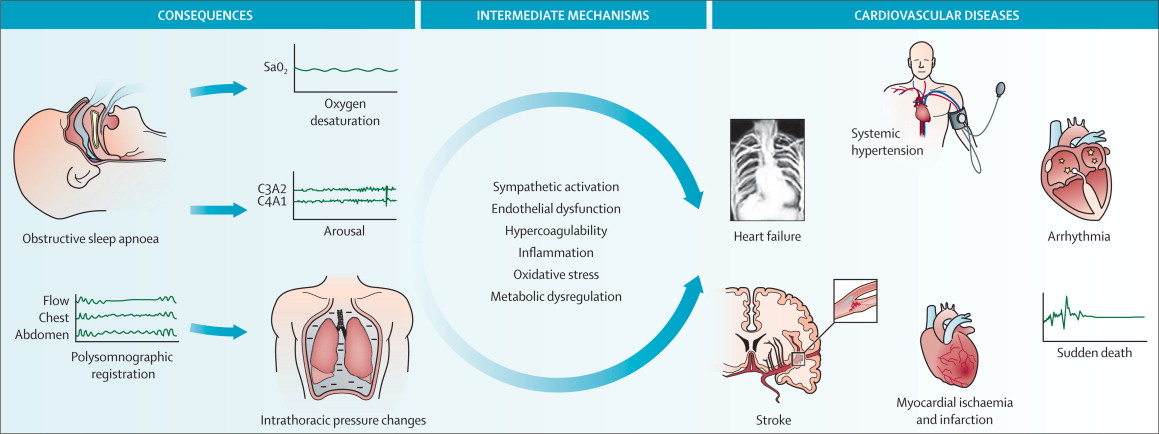
Van slaap-apnee tot hartskade
Stap 1: As jy snags in jou slaap vir sowat 10 sekondes ophou asemhaal, en dan weer met ‘n snak of groot asemteug begin asemhaal, beteken dit dat die suurstofvlakke in jou bloed daal (bekend as hipoksie) en die koolstofdioksiedvlakke in jou bloed styg (bekend as hiperkarbie)
In sommige gevalle kan jou suurstofvlakke so laag daal dat dit slegs 10% van jou normale suurstofvlakke is.
Stap 1 lei tot Stap 2:
Die lae suurstofvlakke en hoë koolstofdioksied-vlakke in jou bloed veroorsaak ‘n staat van skadelike oksidatiewe stress en inflammasie in jou liggaamselle.
Hierdie oksidatiewe stress en inflammasie in ook die endoteel (voeringlagie) van die koronêre vate wat die hart van bloed voorsien, asook die binnevoeringlagie van die hart, veroorsaak skade aan die binnekant van dié bloedvate en die hart.
Stap 2 lei tot groter risiko vir hartaanvalle
Stap 1 lei ook tot Stap 3:
Terselfdertyd veroorsaak die lae suurstofvlakke en hoë koolstofdioksiedvlakke dat die ribbekas se spiere wat jou help om asem te haal, abnormaal begin beweeg.
Stap 3 lei tot Stap 4:
Die abnormale asemhalingsbewegings lei tot verhoogde druk binne-in die borskas. Dit staan bekend as verhoogde intra-torakale druk.
Stap 4 lei tot stap 5:
Verhoogde druk binne-in die borskas lei tot aktivering van die simpatiese senuweesisteem – dit is jou veg-en-vlug reaksie en gaan gepaard met verhoogde noradrenalien (in die brein) en verhoogde adrenalien (wat deur die byniere afgeskei word), want jou liggaam besef jy is in die nood.
Stap 5 lei tot Stap 6:
Die oor-aktivering van jou veg-en-vlug reaksie lei tot skielike stygings in jou bloeddruk en in jou polsspoed (veral in die stadium wat jy ná asem-ophoud weer begin asemhaal) ventrikulêre hartritme-stoornisse, veral tussen 6 vm en 12 vm. Dit gebeur
Stap 6 lei tot stap 7:
Die verhoogde bloeddruk en binne-borskasdruk lei daartoe dat die hart se regterventrikel harder moet pomp om die bloed in die longe te kry. Dit kan lei to regterhartversaking.
Stap 7 lei tot stap 8:
Meer bloed keer terug na die linker-atria (linker vulkamer).
Stap 8 lei na stap 9:
Meer bloed in die linker vulkamer veroorsaak wat dat nog meer bloed na die linker pompkamer vloei. Die linker pompkamer kan ook rek en vergroot en hulle wande verdik.
Stap 2 en 9 lei tot ook tot stap 10:
Die rekking van die pompkamers beskadig die geleidingsweefsel en veroorsaak ook littekenweefsel in die pompkamers.
Dis ‘n giftige kombinasie vir die hart.
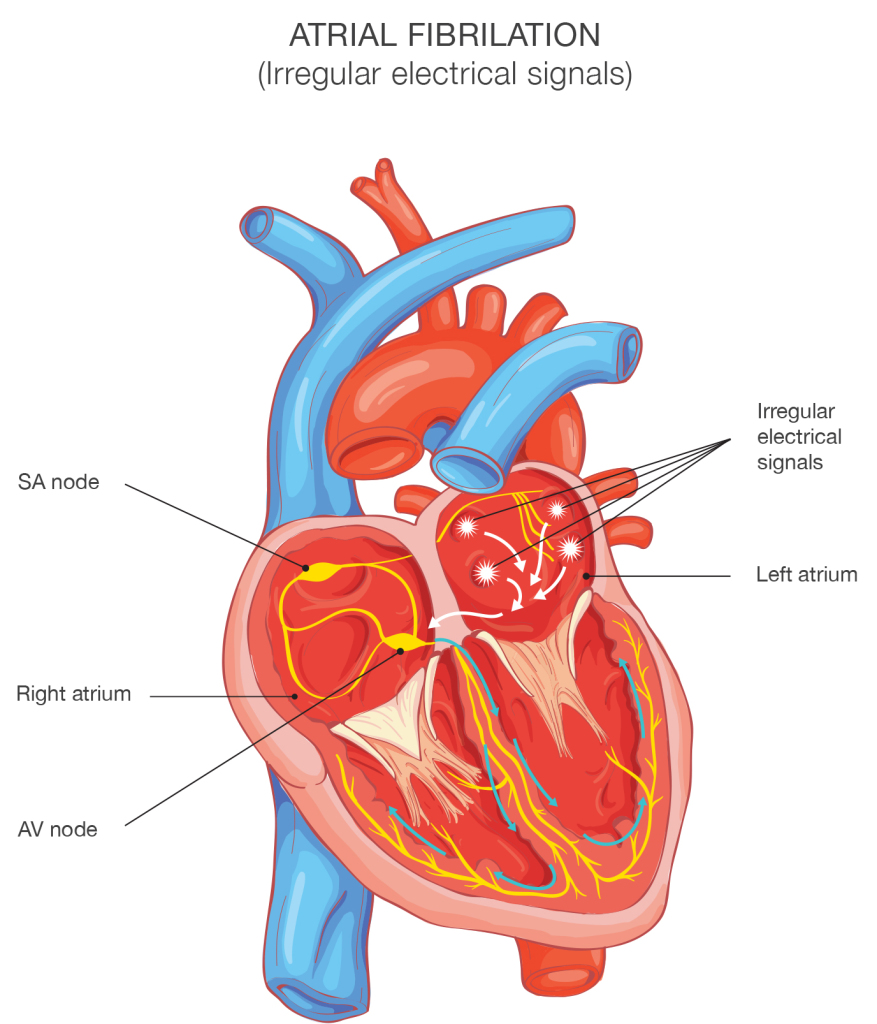
Hart met atriale fibrillasie. Sleutels: SN= SINUS NODE, AVN = ATRIOVENTRIKULêR NODE, BB = BONDELTAKKE
Stap 8 en 9 lei tot stap 11:
Die bloedvloei in die vulkamers vloei nou nie meer in ‘n netjiese stroom nie, maar begin te warrel, weens veral skade aan die geleidingsweefsel in die linker-atrium. Die skade lei ook tot onreelmatige en ongesinchroneerde hartklop, bekend as Atriale Fibrillasie. Tydens AF veroorsaak dié turbulente vloei veroorsaak dat die bloed stadiger aan die buitekant van die turbulensie vloei, en dan begin stolsels vorm. Atriale Fibrillasie is die algemeenste hartritme-defek onder mense ouer as 60 jaar, en een van die oorsake van beroerte.
Stap 11 lei tot stap 12:
Die stolsels kan deur die liggaam gepomp word en in die brein beland (beroerte) of in ledemate of in jou oog.
Stap 12 lei tot stap 13:
‘n Beroerte kan noodlottig wees.
Stap 9 lei ook tot stap 14:
Die risiko vir Skielike hartstilstand, ‘n hartaanval, hartversaking en dood is beslis verhoog.
Diagnose van slaap-apnee
‘n Slaapstudie is nodig waar verskeie dinge soos bloeddruk, suurstofvlakke en veel meer gemeet word. Die asemophoud moet ook minstens 10 sekondes duur.
Die behandeling
As die begenoemde kaskade van gebeure eers aangeskakel is, is dit moeilik om af te skakel en om te keer. Maar dit kan omgekeer word as al die aspekte van die kaskade behandel word.
- As die slaap-apnee die gevolg is van ‘n anatomiese obstruksie in die neus of keel, moet dit reggestel word.
- ‘n C-Pap masker is nodig om te verseker dat jou suurstofvlakke nooit te laag daal nie.
- Jou AF kan behandel word deur ‘n Krioballon-ablasie
- Gewigsverlies en gereelde oefening is ook kardinaal.
Wie het ‘n verhoogde risiko vir Slaap-apnee en hartprobleme en skielike dood?
- Mense met hoë bloeddruk en/of diabetes
- Mense met bestaande hartprobleme
- Oorgewig mense
- Mense wat min oefening doen
- Mense met ‘n dik nek en ‘n groot nek-omtrek.
- Snork/maklik verstik
- Slaap maklik in dag weens moegheid
Latest News:
Eerste in Afrika
Atriale Fibrillasie, algemeense hartritme-defek met nuwe tegnologie behandel Die eerste geval in Afrika waar ’n pasiënt met revolusionêre nuwe tegnologie behandel is om ‘n hartritme-defek te herstel, is Maandag in die Kaapse Skiereiland gedoen. Die nuwe tegnologie bekend as elektro-porasie is uiters nuut, maar baie opwindend en kan moontlik tot ’n omwenteling in die behandeling […]
Watch our recent Masterclass Sessions in Cardiology
Sessions by renowned international cardiology experts Introduction and Welcome: Dr Razeen Gopal, electrophysiologist and director of the Cape Town AF Center. 2. Renal denervation in dthe managent of resistant hypertension: Dr Riaz Dawood, Lenmed Clinic. 3. Complex percutaneous coronary intervention (PCI) for high bleeding risk patients: Prof Ivo Petrov, Univerity of Sofia, Bulgaria. 4. TAVI/Percutaneous […]
Treatment with most advanced therapy for management of atrial fibrillation will change a teenager’s life today
Today an 18-year-old boy with atrial fibrillation (AF) has become the first patient in Africa and the Middle East to be treated with the latest and most advanced therapy available in the management of atrial fibrillation. According to Dr Razeen Gopal, renowned cardiologist and electrophysiologist at the Cape Town AF Centre (CTAFC) based at Mediclinic […]
Why conduction system pacing is the most synchronized physiological pacing modality of the future?
In a nutshell: Patients with a bradycardia (slow heart rate) or conduction system disease, can now be paced more effectively with a procedure referred to as His Bundle Pacing (HBP). The conduction system is stimulated directly, allowing both ventricles to contract simultaneously. This leads to better patient outcomes, and bypasses the risk of developing left […]
Skrik wakker; slaap-apnee beskadig jou hart
Wat het slaap-apnee en snork met jou hart te doen? Baie meer as wat jy ooit kon droom. As jy of jou maat aan snags ophou asemhaal en dan weer skielik na asem snak, MOET jy eenvoudig na dié program luister. Onbehandelde slaap-apnee met hartprobleme kan jou lewe met 20 jaar verkort. Sowat 1 uit […]
Ventricular arrhythmias: New solutions for deadly heart conditions
The first emerging market regions implantation of the world’s smallest smart device to control heart beats and pumping action was performed yesterday by Dr Gopal and his team at the Cape Town AF Centre, Panorama hospital, Cape Town. These devices, known as Implantable cardioverter-defibrillators (ICD), are increasingly being used worldwide and also in developing countries, […]
Nuwe, gevorderde Hisbondel-pasaangeërs laat selfs swak harte sterker klop
Nuwe, gevorderde pasgeër-inplantingsprosedure wat selfs verswakte hart sterker laat klop, is nou in Kaapstad beskikbaar ‘n Té stadige hartklop, is algemeen in ouer mense en is gewoonlik die gevolg van ‘n blokkasie in die hart se spesiale elektriese geleidingsweefsel, soms ná ‘n hartaanval. Nou het medici ‘n manier gevind om die geleidingsweefsel van die hart […]
The Cape Town AF centre is based within the Panorama Mediclinic heart unit which is a private hospital that offers a flexible and speedy service to our insured patients. For patients currently uninsured a special tariff can be negotiated.
The Cape Town AF Centre is different
At the Cape Town AF Centre we believe in the importance of a team approach. The team is built around heart specialists who are both colleagues and friends. We share our experience, consult with each other and will often operate together. Patients are therefore never without help even if their own consultant is away for example on holiday. Our cardiologists have a vast experience between them.

The new Rivacor device
The first emerging market regions implantation of the world’s smallest smart device to control heart beats and pumping action was performed yesterday by Dr Gopal and his team at the Cape Town AF Centre, Panorama hospital, Cape Town.
These devices, known as Implantable cardioverter-defibrillators (ICD), are increasingly being used worldwide and also in developing countries, predominately for the management of life-threatening cardiac rhythm disorders.
The Cape Town AF Centre with its experience of using these devices and its leading role in teaching doctors about electrophysiology, implanted this device in a 77yr old patient with ischaemic cardiomyopathy (poor cardiac function due to coronary artery disease). He has had a successful ablation of his ventricular tachycardia with Dr. Gopal.
The new device, produced by Biotronik, has only recently been introduced in Europe, so this South African application has occurred very early in the introduction of this medical device worldwide.
Unique features of this heart-support device are its greater longevity, reliability and ease of implantation; these are very important attributes in developing environments. The battery of the ICD device lasts for up to 15 years. The more sophisticated device which offers synchronisation of heart chamber pump action plus a ‘shock/defibrillation’ function has a battery which lasts for up to 9 years.
This ultra slim and bio shaped device (10mm) is smart and can provide information directly to the clinic or doctor’s surgery remotely. It can also be kept working while full or partial body scans are done for diagnosis of other diseases.
Dr. Gopal’s unit remains one of the leading centres for management of cardiac arrhythmias on the African continent and he feels that the addition of the new platform of devices is in keeping the centre’s motto that “with innovation, comes cure”.
Latest News:
Eerste in Afrika
Atriale Fibrillasie, algemeense hartritme-defek met nuwe tegnologie behandel Die eerste geval in Afrika waar ’n pasiënt met revolusionêre nuwe tegnologie behandel is om ‘n hartritme-defek te herstel, is Maandag in die Kaapse Skiereiland gedoen. Die nuwe tegnologie bekend as elektro-porasie is uiters nuut, maar baie opwindend en kan moontlik tot ’n omwenteling in die behandeling […]
Watch our recent Masterclass Sessions in Cardiology
Sessions by renowned international cardiology experts Introduction and Welcome: Dr Razeen Gopal, electrophysiologist and director of the Cape Town AF Center. 2. Renal denervation in dthe managent of resistant hypertension: Dr Riaz Dawood, Lenmed Clinic. 3. Complex percutaneous coronary intervention (PCI) for high bleeding risk patients: Prof Ivo Petrov, Univerity of Sofia, Bulgaria. 4. TAVI/Percutaneous […]
Treatment with most advanced therapy for management of atrial fibrillation will change a teenager’s life today
Today an 18-year-old boy with atrial fibrillation (AF) has become the first patient in Africa and the Middle East to be treated with the latest and most advanced therapy available in the management of atrial fibrillation. According to Dr Razeen Gopal, renowned cardiologist and electrophysiologist at the Cape Town AF Centre (CTAFC) based at Mediclinic […]
Why conduction system pacing is the most synchronized physiological pacing modality of the future?
In a nutshell: Patients with a bradycardia (slow heart rate) or conduction system disease, can now be paced more effectively with a procedure referred to as His Bundle Pacing (HBP). The conduction system is stimulated directly, allowing both ventricles to contract simultaneously. This leads to better patient outcomes, and bypasses the risk of developing left […]
Skrik wakker; slaap-apnee beskadig jou hart
Wat het slaap-apnee en snork met jou hart te doen? Baie meer as wat jy ooit kon droom. As jy of jou maat aan snags ophou asemhaal en dan weer skielik na asem snak, MOET jy eenvoudig na dié program luister. Onbehandelde slaap-apnee met hartprobleme kan jou lewe met 20 jaar verkort. Sowat 1 uit […]
Ventricular arrhythmias: New solutions for deadly heart conditions
The first emerging market regions implantation of the world’s smallest smart device to control heart beats and pumping action was performed yesterday by Dr Gopal and his team at the Cape Town AF Centre, Panorama hospital, Cape Town. These devices, known as Implantable cardioverter-defibrillators (ICD), are increasingly being used worldwide and also in developing countries, […]
Nuwe, gevorderde Hisbondel-pasaangeërs laat selfs swak harte sterker klop
Nuwe, gevorderde pasgeër-inplantingsprosedure wat selfs verswakte hart sterker laat klop, is nou in Kaapstad beskikbaar ‘n Té stadige hartklop, is algemeen in ouer mense en is gewoonlik die gevolg van ‘n blokkasie in die hart se spesiale elektriese geleidingsweefsel, soms ná ‘n hartaanval. Nou het medici ‘n manier gevind om die geleidingsweefsel van die hart […]
The Cape Town AF centre is based within the Panorama Mediclinic heart unit which is a private hospital that offers a flexible and speedy service to our insured patients. For patients currently uninsured a special tariff can be negotiated.
The Cape Town AF Centre is different
At the Cape Town AF Centre we believe in the importance of a team approach. The team is built around heart specialists who are both colleagues and friends. We share our experience, consult with each other and will often operate together. Patients are therefore never without help even if their own consultant is away for example on holiday. Our cardiologists have a vast experience between them.
 28 January 2019
DR GOPAL PERFORMS 600th CRYO-ABLATION PROCEDURE
Dr Razeen Gopal, renowned cardiologist and electrophysiologist based at Mediclinic Panorama, performed his 600th cryo-ablation procedure on Monday, 21 January 2019. According to Medtronic South Africa, this is the first time a single operator has completed 600 cryo cases within the MEACAT (Middle East
Africa and Turkey) region.
In 2011 Dr Gopal was one of the first South African specialists to start performing these procedures in high volumes.
The 600th patient, Mr Paul Dinsmore, aged 61, from Newlands is a telecoms consultant and avid endurance trainer, and was referred to Dr Gopal for the ablation procedure. He underwent the surgery on Monday and hopes to return to endurance training in the near future.
Cryo-ablation makes use of extremely low temperature (intense cold energy) to eliminate the
effect of malfunctioning cells that spark additional electrical signals. The heart’s rhythm and
rate can therefore be regulated. Two catheters are inserted through the groin and into the femoral veins, which are then pushed up into the right atrium of the heart. They are positioned in the left atrium through two small holes made in the septum between the two chambers. A cryo-balloon is inserted at the base of one of the four pulmonary veins, inflated and cooled. This cooling from the balloon creates a contiguous ring of strategically damaged heart tissue, which effectively blocks faulty signals. The process is then repeated on the other three veins.
Latest News:
Eerste in Afrika
Atriale Fibrillasie, algemeense hartritme-defek met nuwe tegnologie behandel Die eerste geval in Afrika waar ’n pasiënt met revolusionêre nuwe tegnologie behandel is om ‘n hartritme-defek te herstel, is Maandag in die Kaapse Skiereiland gedoen. Die nuwe tegnologie bekend as elektro-porasie is uiters nuut, maar baie opwindend en kan moontlik tot ’n omwenteling in die behandeling […]
Watch our recent Masterclass Sessions in Cardiology
Sessions by renowned international cardiology experts Introduction and Welcome: Dr Razeen Gopal, electrophysiologist and director of the Cape Town AF Center. 2. Renal denervation in dthe managent of resistant hypertension: Dr Riaz Dawood, Lenmed Clinic. 3. Complex percutaneous coronary intervention (PCI) for high bleeding risk patients: Prof Ivo Petrov, Univerity of Sofia, Bulgaria. 4. TAVI/Percutaneous […]
Treatment with most advanced therapy for management of atrial fibrillation will change a teenager’s life today
Today an 18-year-old boy with atrial fibrillation (AF) has become the first patient in Africa and the Middle East to be treated with the latest and most advanced therapy available in the management of atrial fibrillation. According to Dr Razeen Gopal, renowned cardiologist and electrophysiologist at the Cape Town AF Centre (CTAFC) based at Mediclinic […]
Why conduction system pacing is the most synchronized physiological pacing modality of the future?
In a nutshell: Patients with a bradycardia (slow heart rate) or conduction system disease, can now be paced more effectively with a procedure referred to as His Bundle Pacing (HBP). The conduction system is stimulated directly, allowing both ventricles to contract simultaneously. This leads to better patient outcomes, and bypasses the risk of developing left […]
Skrik wakker; slaap-apnee beskadig jou hart
Wat het slaap-apnee en snork met jou hart te doen? Baie meer as wat jy ooit kon droom. As jy of jou maat aan snags ophou asemhaal en dan weer skielik na asem snak, MOET jy eenvoudig na dié program luister. Onbehandelde slaap-apnee met hartprobleme kan jou lewe met 20 jaar verkort. Sowat 1 uit […]
Ventricular arrhythmias: New solutions for deadly heart conditions
The first emerging market regions implantation of the world’s smallest smart device to control heart beats and pumping action was performed yesterday by Dr Gopal and his team at the Cape Town AF Centre, Panorama hospital, Cape Town. These devices, known as Implantable cardioverter-defibrillators (ICD), are increasingly being used worldwide and also in developing countries, […]
Nuwe, gevorderde Hisbondel-pasaangeërs laat selfs swak harte sterker klop
Nuwe, gevorderde pasgeër-inplantingsprosedure wat selfs verswakte hart sterker laat klop, is nou in Kaapstad beskikbaar ‘n Té stadige hartklop, is algemeen in ouer mense en is gewoonlik die gevolg van ‘n blokkasie in die hart se spesiale elektriese geleidingsweefsel, soms ná ‘n hartaanval. Nou het medici ‘n manier gevind om die geleidingsweefsel van die hart […]
The Cape Town AF centre is based within the Panorama Mediclinic heart unit which is a private hospital that offers a flexible and speedy service to our insured patients. For patients currently uninsured a special tariff can be negotiated.
The Cape Town AF Centre is different
At the Cape Town AF Centre we believe in the importance of a team approach. The team is built around heart specialists who are both colleagues and friends. We share our experience, consult with each other and will often operate together. Patients are therefore never without help even if their own consultant is away for example on holiday. Our cardiologists have a vast experience between them.
 Waarom klop ’n mens se hart soms te vinnig, te stadig of onreëlmatig? Wanneer is dit gevaarlik? Kan of moet dit behandel word? Hoe word dit behandel?
Luister hier na die onderhoud wat Marí Hudson op RSG gevoer het oor hartritme-defekte wat in die pompkamers ontstaan met Dr Razeen Gopal, hartritme-spesialis van die Kaapstad Sentrum.
 Laai Af (26 223KB)
 Teken in met iTunes
Latest News:
Eerste in Afrika
Atriale Fibrillasie, algemeense hartritme-defek met nuwe tegnologie behandel Die eerste geval in Afrika waar ’n pasiënt met revolusionêre nuwe tegnologie behandel is om ‘n hartritme-defek te herstel, is Maandag in die Kaapse Skiereiland gedoen. Die nuwe tegnologie bekend as elektro-porasie is uiters nuut, maar baie opwindend en kan moontlik tot ’n omwenteling in die behandeling […]
Watch our recent Masterclass Sessions in Cardiology
Sessions by renowned international cardiology experts Introduction and Welcome: Dr Razeen Gopal, electrophysiologist and director of the Cape Town AF Center. 2. Renal denervation in dthe managent of resistant hypertension: Dr Riaz Dawood, Lenmed Clinic. 3. Complex percutaneous coronary intervention (PCI) for high bleeding risk patients: Prof Ivo Petrov, Univerity of Sofia, Bulgaria. 4. TAVI/Percutaneous […]
Treatment with most advanced therapy for management of atrial fibrillation will change a teenager’s life today
Today an 18-year-old boy with atrial fibrillation (AF) has become the first patient in Africa and the Middle East to be treated with the latest and most advanced therapy available in the management of atrial fibrillation. According to Dr Razeen Gopal, renowned cardiologist and electrophysiologist at the Cape Town AF Centre (CTAFC) based at Mediclinic […]
Why conduction system pacing is the most synchronized physiological pacing modality of the future?
In a nutshell: Patients with a bradycardia (slow heart rate) or conduction system disease, can now be paced more effectively with a procedure referred to as His Bundle Pacing (HBP). The conduction system is stimulated directly, allowing both ventricles to contract simultaneously. This leads to better patient outcomes, and bypasses the risk of developing left […]
Skrik wakker; slaap-apnee beskadig jou hart
Wat het slaap-apnee en snork met jou hart te doen? Baie meer as wat jy ooit kon droom. As jy of jou maat aan snags ophou asemhaal en dan weer skielik na asem snak, MOET jy eenvoudig na dié program luister. Onbehandelde slaap-apnee met hartprobleme kan jou lewe met 20 jaar verkort. Sowat 1 uit […]
Ventricular arrhythmias: New solutions for deadly heart conditions
The first emerging market regions implantation of the world’s smallest smart device to control heart beats and pumping action was performed yesterday by Dr Gopal and his team at the Cape Town AF Centre, Panorama hospital, Cape Town. These devices, known as Implantable cardioverter-defibrillators (ICD), are increasingly being used worldwide and also in developing countries, […]
Nuwe, gevorderde Hisbondel-pasaangeërs laat selfs swak harte sterker klop
Nuwe, gevorderde pasgeër-inplantingsprosedure wat selfs verswakte hart sterker laat klop, is nou in Kaapstad beskikbaar ‘n Té stadige hartklop, is algemeen in ouer mense en is gewoonlik die gevolg van ‘n blokkasie in die hart se spesiale elektriese geleidingsweefsel, soms ná ‘n hartaanval. Nou het medici ‘n manier gevind om die geleidingsweefsel van die hart […]
The Cape Town AF centre is based within the Panorama Mediclinic heart unit which is a private hospital that offers a flexible and speedy service to our insured patients. For patients currently uninsured a special tariff can be negotiated.
The Cape Town AF Centre is different
At the Cape Town AF Centre we believe in the importance of a team approach. The team is built around heart specialists who are both colleagues and friends. We share our experience, consult with each other and will often operate together. Patients are therefore never without help even if their own consultant is away for example on holiday. Our cardiologists have a vast experience between them.
Nuwe, gevorderde pasgeër-inplantingsprosedure wat selfs verswakte hart sterker laat klop, is nou in Kaapstad beskikbaar
‘n Té stadige hartklop, is algemeen in ouer mense en is gewoonlik die gevolg van ‘n blokkasie in die hart se spesiale elektriese geleidingsweefsel, soms ná ‘n hartaanval. Nou het medici ‘n manier gevind om die geleidingsweefsel van die hart vir die eerste keer regstreeks te stimuleer sodat die twee pompkamers weer presies soos ‘n normale hart saamtrek: sterk en sinchronies. Die nuwe, gevorderde pasaangeër-prosedure staan bekend as His-bondel-pasaandrywing.
Die inplanting van die eerste reeks leermeester-gedrewe His-bondeltak-pasaangeërs is op 2 en 3 Mei by die Kaapstad AF sentrum in Mediclinic Panorama gedoen.
”Ek beskou His-bondeltak-pasaandrywing as die pasaangeër-prosedure van die toekoms beskryf omdat dit die eerste metode is waar die hart se eie geleidingsweefsel regstreeks gestimuleer word en só die hart se twee pompkamers weer gesinchroniseerd en sterk laat saamtrek,” het dr. Razeen Gopal, kardiale elektrofisioloog van die Kaapstad AF Sentrum, wat die reeks gelei het, gesê.
“Ons sal dit in die toekoms beskryf as die ‘herstel van sinchroniese sametrekking’ wat ‘n stap verder is as bloot pasaandrywing,” sê dr. Gopal.
Reeds tydens die inplantingsprosedure, wat gemiddeld skaars 20 minute duur, kan duidelik gesien word hoe selfs ‘n verswakte hart se EKG-golwe weer fisiologies normaal word omdat die twee pompkamers weer sterk en sinchronies saamtrek, wat nie voorheen met tradisionele pasaangeërs vermag kon word nie.
Al ses pasiënte wat in die eerste reeks met dié nuwe en gevorderde metode pasaangeërs ontvang het waar die elektrodes op ‘n nuwe manier ingeplant is, se prosedures was suksesvol. Almal voel meer energiek en se kwaliteit van lewe het verbeter, juis omdat sinchroniese sametrekking van die twee pompkamers herstel is, het dr. Gopal bevestig.
Die Kaapstad AF Sentrum is slegs die tweede sentrum in die land waar His-bondel-pasaandrywing gedoen is, en die eerste waar die eerste reeks onder leermeester-toesig gedoen is. Dr Israel Obel van Netcare Milpark Hospital in Johannesburg het in Julie verlede jaar die eerste His-bondel-pasaangeër in Suid-Afrika in ‘n pasiënt ingeplant en sedertdien nog sowat vyf gevalle gedoen. Dr. Gopal is gereed om binnekort die tweede reeks pasiënte te behandel.
Hoe werk normale hart-geleiding en die prosedure?

Die His-bondeltakselle is die geleidingsweefsel wat uit die AV-node volg. Met His-bondeltak-pasaandrywing word die selle regstreeks gestimuleer, en dít lei tot normale, sinchroniese sametrekking van die twee pompkamers.
Die prosedure word His-bondel-pasaandrywing genoem omdat die hoof-elektrode van die pasaangeër nie bloot in die regter-pompkamer geplaas word nie, maar met ‘n spesiale skroefpunt teen die His-bondeltak, die hart se eie geleidingsweefsel wat die boonste deel van die hart elektries met die onderste deel van die hart verbind. Die prosedure is ingewikkelder as die inplasing van die elektrodes van tradisionele pasaangeërs.
Die His-bondeltak verloop van bo na onder in die septum tussen die linker- en regterhartkamers, en vertak in twee of drie bondeltakke wat na en om die pompkamers verloop. Dié bondeltakke bestaan uit spesiale geleidingselle wat die elektriese seine soos blits gelei sodat die elektriese stroom bykans oombliklik en gelyktydig albei pompkamers bereik en dus gelyktydig prikkel om gelyktydig saam te trek. Die gelyktydige, gesinchroniseerde sametrekking deur beide pompkamers is noodsaaklik om maksimum uitwerping van die bloed uit die twee pompkamers te verkry.

Pleks daarvan om die elektrode in die regterventrikel te plaas, word dit teen die septum geplaas sodat die His-bondel regstreeks gestimuleer kan word.
Met ‘n gewone pasaangeër, waar die elektrode in die regter-pompkamer geplaas word, word die impulse vanaf die elektrode nie deur die elektriese ‘snelweg’ gelei nie, maar stadiger deur die gewone hartspierselle. Omdat die pad na die linker-pompkamer langer is as na die regter-pompkamer, bereik die impulse die linkerkant later, en trek die linker-pompkamer eers ‘n sekonde of meer ná die regterkant saam. Op die lang duur, kan ongesinchroniseerde sametrekking van die twee pompkamers stremming op die hart plaas, en begin die EKG-golwe lyk soos linkerbondel-blok. Elke millisekonde verskil in die sametrekkings-aanvang tussen die twee pompkamers, kan weliswaar ‘n verskil maak aan hoe sterk die hart as geheel klop.
Die toekoms
”His-bondel-pasaandrywing is die eerste fisiologies-korrekte pasaandrywing”, het Dr. Zachary Whinnett, kardiale elektrofisioloog verbonde aan die Nasionale Hart- en Longinstituut by die Geneeskunde fakulteit van die Imperial College NHS Trust en die Hammersmith en St Mary’s Hospitale in London verduidelik. Hy was in Suid-Afrika as ‘proctor’ oftewel spesialis-leermeester om dr. Gopal by te staan in dié reeks wat in Kaapstad gedoen is.
Die inplanting van His-bondeltak-pasaangeërs is nog in sy kinderskoene en die data van dubbel-blinde kliniese studies is nog nie beskikbaar nie, maar Dr. Whinnett beskou dit as die soort pasaangewing van die toekoms veral vir pasiënte met ‘n stadige hartklop weens hartblok of bondeltakblok van enige van die His-bondeltakke, en met boon-op verswakte hartfunksie, juis omdat die hart se pompkamers ná His-bondeltak-pasaangewing weer sinchronies en dus sterkter saamtrek.

Dr Razeen Gopal (links) en dr. Zachary Whinnett van die Imperial mediese skool en hospitaal in Londen.
Luister hier hoe dr. Gopal self verduidelik hoe en waarom His-bondel-pasaandrywing gedoen word en watter pasiënte gehelp kan word:
New treatment option made available to patients with irregular heartbeat
Advanced cardiac pacemaker procedure performed for first time under proctor supervision in SA
The ‘His-bundle’ is electrically connecting the upper and lower chambers of the heart.
A heart rhythm disorder or cardiac arrhythmia is when the heart beats too quickly, too slowly or irregularly. This is caused by a fault or faults in the electrical circuitry of the heart.
Electrophysiology is the study of the electrical properties of the heart’s cells and tissues and aims to diagnose and successfully treat cardiac arrhythmia.
While many South Africans are unaware of the medical condition, an irregular heart beat or arrhythmia is actually quite common, and in some cases can be extremely serious, causing a sudden, cardiac event such as heart failure.
Latest News:
Eerste in Afrika
Atriale Fibrillasie, algemeense hartritme-defek met nuwe tegnologie behandel Die eerste geval in Afrika waar ’n pasiënt met revolusionêre nuwe tegnologie behandel is om ‘n hartritme-defek te herstel, is Maandag in die Kaapse Skiereiland gedoen. Die nuwe tegnologie bekend as elektro-porasie is uiters nuut, maar baie opwindend en kan moontlik tot ’n omwenteling in die behandeling […]
Watch our recent Masterclass Sessions in Cardiology
Sessions by renowned international cardiology experts Introduction and Welcome: Dr Razeen Gopal, electrophysiologist and director of the Cape Town AF Center. 2. Renal denervation in dthe managent of resistant hypertension: Dr Riaz Dawood, Lenmed Clinic. 3. Complex percutaneous coronary intervention (PCI) for high bleeding risk patients: Prof Ivo Petrov, Univerity of Sofia, Bulgaria. 4. TAVI/Percutaneous […]
Treatment with most advanced therapy for management of atrial fibrillation will change a teenager’s life today
Today an 18-year-old boy with atrial fibrillation (AF) has become the first patient in Africa and the Middle East to be treated with the latest and most advanced therapy available in the management of atrial fibrillation. According to Dr Razeen Gopal, renowned cardiologist and electrophysiologist at the Cape Town AF Centre (CTAFC) based at Mediclinic […]
Why conduction system pacing is the most synchronized physiological pacing modality of the future?
In a nutshell: Patients with a bradycardia (slow heart rate) or conduction system disease, can now be paced more effectively with a procedure referred to as His Bundle Pacing (HBP). The conduction system is stimulated directly, allowing both ventricles to contract simultaneously. This leads to better patient outcomes, and bypasses the risk of developing left […]
Skrik wakker; slaap-apnee beskadig jou hart
Wat het slaap-apnee en snork met jou hart te doen? Baie meer as wat jy ooit kon droom. As jy of jou maat aan snags ophou asemhaal en dan weer skielik na asem snak, MOET jy eenvoudig na dié program luister. Onbehandelde slaap-apnee met hartprobleme kan jou lewe met 20 jaar verkort. Sowat 1 uit […]
Ventricular arrhythmias: New solutions for deadly heart conditions
The first emerging market regions implantation of the world’s smallest smart device to control heart beats and pumping action was performed yesterday by Dr Gopal and his team at the Cape Town AF Centre, Panorama hospital, Cape Town. These devices, known as Implantable cardioverter-defibrillators (ICD), are increasingly being used worldwide and also in developing countries, […]
Nuwe, gevorderde Hisbondel-pasaangeërs laat selfs swak harte sterker klop
Nuwe, gevorderde pasgeër-inplantingsprosedure wat selfs verswakte hart sterker laat klop, is nou in Kaapstad beskikbaar ‘n Té stadige hartklop, is algemeen in ouer mense en is gewoonlik die gevolg van ‘n blokkasie in die hart se spesiale elektriese geleidingsweefsel, soms ná ‘n hartaanval. Nou het medici ‘n manier gevind om die geleidingsweefsel van die hart […]
The Cape Town AF centre is based within the Panorama Mediclinic heart unit which is a private hospital that offers a flexible and speedy service to our insured patients. For patients currently uninsured a special tariff can be negotiated.
The Cape Town AF Centre is different
At the Cape Town AF Centre we believe in the importance of a team approach. The team is built around heart specialists who are both colleagues and friends. We share our experience, consult with each other and will often operate together. Patients are therefore never without help even if their own consultant is away for example on holiday. Our cardiologists have a vast experience between them.

Dr Gopal (regs) en prof. Adama Kane, by ‘n 14-jarige pasiënt in die eenvoudige herstelkamer ná ‘n prosedure.
6 April 2018. – Dr Razeen Gopal het pas teruggekeer van ‘n geslaagde humanitêre missie na Dakar Senegal, waar hy binne vier dae ablasie-prosedures op 18 pasiënte met lewensgevaarlike hartritme-defekte, uitgevoer het.
Dr. Gopal het op versoek van prof. Adama Kane, kardioloog van die Institiuut vir Kardiologiese Intervensies in Dakar gaan help om dié pasiënte te help. Al die pasiënte was jonger as 30 jaar.
Prof. Kane werk in ‘n hospitaal wat soos in ‘n ouerige huis lyk, in ‘n teater met toerusting wat ouer as 10 jaar is. Prof. Adama het opleiding in Frankryk ontvang en ook opleiding in prosedures om basiese hartritme-defekte te behandel, in Kaapstad onder dr. Gopal ondergaan het. Deel van die doel van die missie, was om Prof. Adama te help om self van die hartritme-defekte te kan herstel.
Dr. Gopal is vergesel deur Ryan Leon, kliniese tegnoloog in kardiologie/elektrofisiologie. Die twee het die eerste dag ná hul aankoms bestee om die beskikbare toerusting te herstel en so veilig moontlik te maak vir die pasiënte. Daarna het hulle 18 pasiënte met lewensbedreigende Wolff-Parkinson-White hartritme-defek, gehelp, deur die bron van die addisionele elektriese stroombaan in die hart, te inaktiveer deur radiofrekwensie (termiese of hitte-) ablasie.
Twee van die pasiënte se addisionele elektriese stroombane was op té gevaarlike plekke in die hart gelëe om met die ou toerusting te behandel, en sal nou op Dr. Gopal se versoek na Kaapstad kom sodat hy die prosedures hier kan doen.
Hier is ‘n video van die gebeure wat deur die Franssprekende televisiekanaal in Dakar gemaak is:

WOLFF-PARKSINSON-WHITE is ‘n arritmie wat veroorsaak word deur ‘n abnormale brug van elektriese weefsel wat die artria en ventrikels verbind. Hierdie ekstra elektriese stroombaan laat toe dat elektriese seine heen en weer tussen die boonste en onderste hartkamer kan hardloop sonder dat dit deur die AV-node gelei word. Die gevolg is ‘n baie vinnige hartklop wat lewensgevaarlik kan wees.
(Lees meer hartritme-defekte in die boekie inEngels en in Afrikaans.
Die missie is verder moontlik gemaak deur verskaffers van toerusting, soos Medtronic, Boston Scientific en andere, wat die prosedures moontlik gemaak het.

Dr Gopal en prof. Kane.

Die hospitaal.

Dr Gopal en prof. Kane in die teater.

In die teater.

Prof. Adama Kane besig met ‘n prosedure onder die wakende oog van Dr. Gopal.

Die span wat saam met Dr. Gopal gewerk het en wat ook opleiding on sy toesig ondergaan het, voor die Instituut vir Kardiologie-intervensies in Dakar. Die Instituut lyk inderwaarheid soos ‘n groot ou huis en die kardioloog probeer met min toerusting ‘n goeie diens aan die pasiënte lewer.

Dr Gopal (heel regs) voer die ablasie-prosedures uit in ‘n karig-toegeruste teater. Die tegnoloë sit in die hoek links voor in die teater.

Kliniese elektrofisiologie-tegnoloog Ryan Leon maak sy kollegas in Dakar touwys.

Die herstelkamer is karig.

Dr. Gopal is met ope arms ontvang.

Dr. Gopal, Ryan Leon en Malika Sydow van Medtronic.

Om die draai van die hospitaal.
Latest News:
Eerste in Afrika
Atriale Fibrillasie, algemeense hartritme-defek met nuwe tegnologie behandel Die eerste geval in Afrika waar ’n pasiënt met revolusionêre nuwe tegnologie behandel is om ‘n hartritme-defek te herstel, is Maandag in die Kaapse Skiereiland gedoen. Die nuwe tegnologie bekend as elektro-porasie is uiters nuut, maar baie opwindend en kan moontlik tot ’n omwenteling in die behandeling […]
Watch our recent Masterclass Sessions in Cardiology
Sessions by renowned international cardiology experts Introduction and Welcome: Dr Razeen Gopal, electrophysiologist and director of the Cape Town AF Center. 2. Renal denervation in dthe managent of resistant hypertension: Dr Riaz Dawood, Lenmed Clinic. 3. Complex percutaneous coronary intervention (PCI) for high bleeding risk patients: Prof Ivo Petrov, Univerity of Sofia, Bulgaria. 4. TAVI/Percutaneous […]
Treatment with most advanced therapy for management of atrial fibrillation will change a teenager’s life today
Today an 18-year-old boy with atrial fibrillation (AF) has become the first patient in Africa and the Middle East to be treated with the latest and most advanced therapy available in the management of atrial fibrillation. According to Dr Razeen Gopal, renowned cardiologist and electrophysiologist at the Cape Town AF Centre (CTAFC) based at Mediclinic […]
Why conduction system pacing is the most synchronized physiological pacing modality of the future?
In a nutshell: Patients with a bradycardia (slow heart rate) or conduction system disease, can now be paced more effectively with a procedure referred to as His Bundle Pacing (HBP). The conduction system is stimulated directly, allowing both ventricles to contract simultaneously. This leads to better patient outcomes, and bypasses the risk of developing left […]
Skrik wakker; slaap-apnee beskadig jou hart
Wat het slaap-apnee en snork met jou hart te doen? Baie meer as wat jy ooit kon droom. As jy of jou maat aan snags ophou asemhaal en dan weer skielik na asem snak, MOET jy eenvoudig na dié program luister. Onbehandelde slaap-apnee met hartprobleme kan jou lewe met 20 jaar verkort. Sowat 1 uit […]
Ventricular arrhythmias: New solutions for deadly heart conditions
The first emerging market regions implantation of the world’s smallest smart device to control heart beats and pumping action was performed yesterday by Dr Gopal and his team at the Cape Town AF Centre, Panorama hospital, Cape Town. These devices, known as Implantable cardioverter-defibrillators (ICD), are increasingly being used worldwide and also in developing countries, […]
Nuwe, gevorderde Hisbondel-pasaangeërs laat selfs swak harte sterker klop
Nuwe, gevorderde pasgeër-inplantingsprosedure wat selfs verswakte hart sterker laat klop, is nou in Kaapstad beskikbaar ‘n Té stadige hartklop, is algemeen in ouer mense en is gewoonlik die gevolg van ‘n blokkasie in die hart se spesiale elektriese geleidingsweefsel, soms ná ‘n hartaanval. Nou het medici ‘n manier gevind om die geleidingsweefsel van die hart […]
The Cape Town AF centre is based within the Panorama Mediclinic heart unit which is a private hospital that offers a flexible and speedy service to our insured patients. For patients currently uninsured a special tariff can be negotiated.
The Cape Town AF Centre is different
At the Cape Town AF Centre we believe in the importance of a team approach. The team is built around heart specialists who are both colleagues and friends. We share our experience, consult with each other and will often operate together. Patients are therefore never without help even if their own consultant is away for example on holiday. Our cardiologists have a vast experience between them.
IN A FIRST IN SUB-SAHARAN AFRICA, A NEW-GENERATION SHOCK DEVICE TO PREVENT SUDDEN CARDIAC DEATH WAS IMPLANTED AT MEDICLINIC PANORAMA TODAY
Panorama – On Monday 21 November 2016 Dr Razeen Gopal, Cardiac Electrophysiologist at the Cape Town AF Centre located at Mediclinic Panorama, implanted a shock device under the skin without a single wire touching the heart of the patient. Mr.Jan Wiehman (55) of Welgemoed, Bellville became the first patient in Africa to receive a subcutaneous shock device, also known as a Subcutaneous Cardioverter Defibrillator (S-ICD), to prevent sudden cardiac death in the patient.
The second procedure is currently in progress, and Dr Gopal will perform the third tomorrow (Tuesday 22 November 2016), to complete the first series of subcutaneous cardioverter defibrillator implants in Sub-Saharan Africa.
Sudden cardiac arrest (SCA) is a serious, life-threatening medical emergency that happens abruptly and without warning. During SCA, the heart’s electrical system malfunctions, and the heart is no longer able to pump blood effectively to the rest of the body. The lack of blood to the brain causes the person to lose consciousness quickly. If the heart is not shocked back into normal rhythm within less than three minutes, brain damage and death can occur.
The first patient, Jan Wiehman, an ardent cyclist, suffered sudden cardiac arrest three years ago on 1 December 2013 during a cycle race in Stellenbosch. He was in the leading pack when he suddenly collapsed. “My brain was awake, but I could not move”, he told us during an interview. Miraculously his life was saved by paramedics on duty, who transported him to a hospital in Paarl where his heart was shocked into normal rhythm in time. Doctors who studied the ECG which were taken during his cardiac arrest, could not believe that he had survived this near- fatal event. Jan remained asymptomatic for two and a half years. He eventually developed symptoms such as sudden palpitations and lightheadedness. After a battery of tests and assessments, doctors recommended the implantation of a cardioverter fibrillator due to his high risk for sudden cardiac arrest.
The EMBLEM S-ICD System is the first and only FDA approved product with both the device and the leads inserted beneath the skin, with no leads inserted through any veins, and thus with no leads placed inside or even touching the heart at all. “This leaves the heart and blood vessels untouched and so provides a safer alternative to conventional implantable defibrillators without the complications associated with cardiac wires,” explains Dr Gopal.
“Unlike traditional implantable defibrillators, it does not require leads in the venous system, eliminating potential sources of complications related to such leads or pockets, the most feared being infection,” said Dr Gopal.
This is of particular importance in young patients, since the new, subcutaneous device can simply be pulled out and removed. A traditional transvenous system can only be removed during delicate surgery since the wires tend to become submerged and entwined in scar tissue.
Dr Gopal explains more about the indications for the implant and the benefits:
Patients at risk of sudden cardiac arrest (and thus sudden cardiac death), include patients with the following heart rhythm defects:
- Patients with ventricular tachycardia (VT) may suffer from a sudden fast heart beat exceeding 100 beats per minute. Symptoms include shortness of breath, palpitations, lightheadedness, chest pain, and fainting. In an adult patient VT may arise due to scar tissue in the heart after a heart attack;
- Patients at risk for ventricular fibrillation – characterised by a fast, but weak and unco-ordinated heart beat – and heart failure; Ventricular fibrillation is a non-perfusing rhythm and not compatable with life.
- Patients (mostly children) with Wolf-Parkinson-White syndrome and other ventricular arrhytmias (mostly congenital), where an ablation did not suffice to prevent sudden fast heart rates (of 160 – 220, and even 250 – 300 beats per minute in stead of the normal rate of 60 – 90 beats per minute) which may lead to sudden death.
- Patients with Long QT syndrome. Undiagnosed, this defect in the conduction tissue of the heart, may lead to sudden death of a healthy, young individual, often while swimming or collapsing on a sports field.
 The Subcutaneous Implantable Cardioverter Defibrillator shock device is 83.1mm wide, 69,1mm high and 12.77mm thick and weighs 130 gram and is implanted in a space between two muscles on the left side of the patient’s body.
The procedure is explained in this video:
The ten steps of the procedure are:
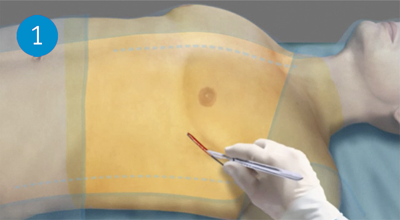
Step 1: Draping and preparation of patient for general anaesthesia and the procedure. The patient thorax is marked for precision incisions. The patient was wheeled into theater at 10:00 after some preparatory tests.


Dr Razeen Gopal (left) and prof Tim Betts from Oxford
Step 2: The first incision is made on the lower left breast line of the patient. The first incision was performed at 11:oo after the doctors plotted the incisions meticulously.
Step 3: The device is placed in a space between two muscles in the left flank (the Latissimus dorsi muscle and the Serratus anterior muscle).

Step 4: A tunnel is created underneath the skin adjacent to the sternum (breast bone).

Step 5: The shock lead is positioned to run firstly from the device underneath the skin, to the bottom of the sternum – thus from the left side of the thorax to the centre of the thorax.

Step 6: Then the lead is pulled upwards through the tunnel under the skin. The second half of the lead makes a 90 degree turn and runs straight upwards adjacent to the sternum, but below the skin.

Step 7: Dr Gopal and team check that there is no air trapped in the tunnel. They also check that the lead is positioned as close as possible to the bone. This is of particular importance in a patient with a high body fat content, since fat around the lead will increase electrical resistance and may disrupt the electrical signals.
Step 8: With the device and lead in place, the doctor stimulates the heart to create ventricular tachycardia in the patient, to check if the device will recognise and diagnose a potentially fatal heart rhythm immediately and deliver an appropiate shock to the heart in order for the heart to regain normal (sinus) rhythm. The shock was administer at 13:21 and the device reacted 14 seconds later to shock the heart back into normal rhythm.
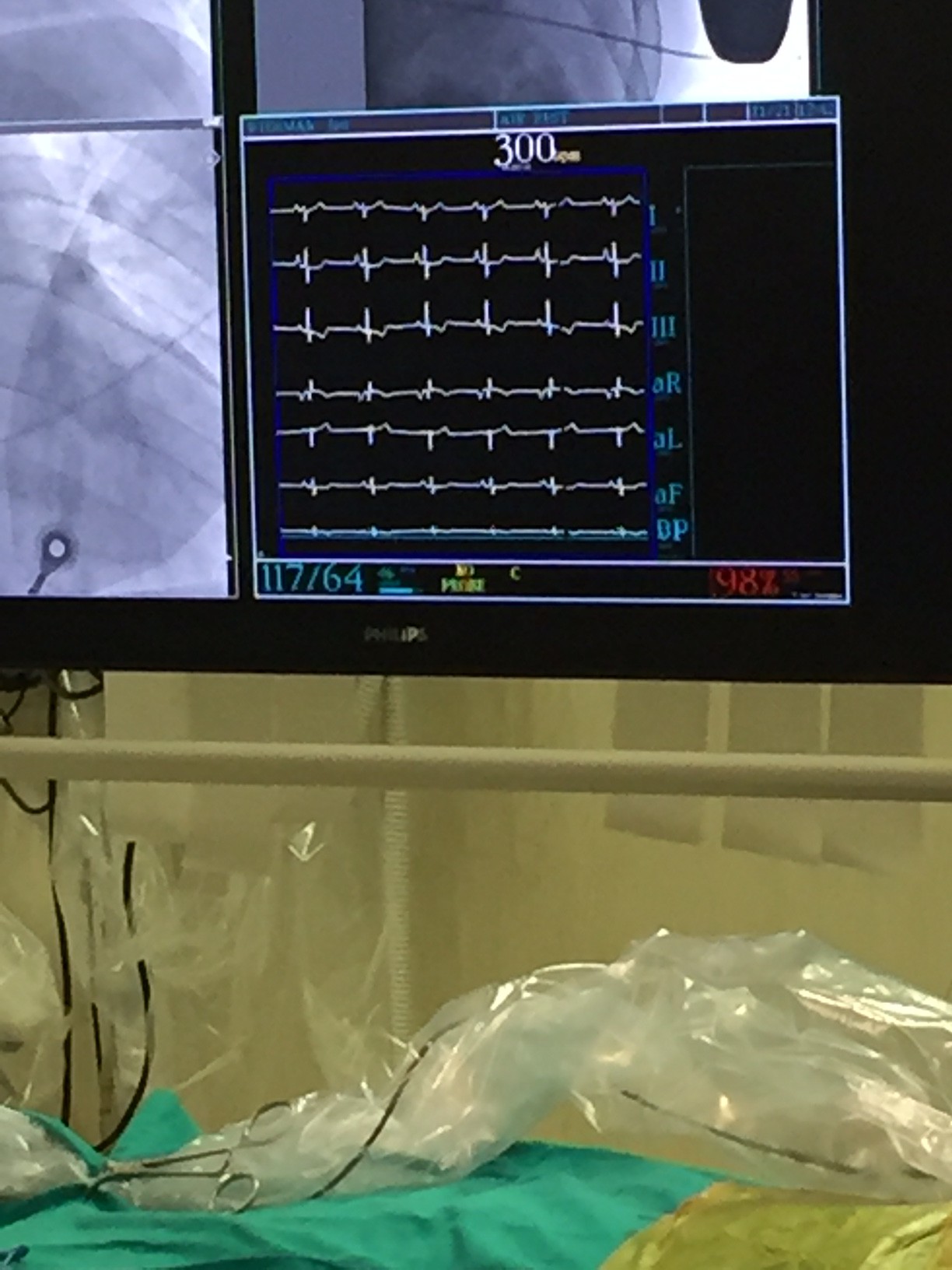
The patient’s heart was stimulated and beats at 300 betas per minute.
Step 9: If the doctors are happy that the device reacts appropiately, they close the incisions and will wake the patient soon afterwards. The patient was wheeled to the cardiac ICU at 14:00.
Step 10: Most patients will be discharged a day later. At 17:00 the patient was sitting up and smiling for a picture. He was not in pain and quite chirpy. He talked about his cardiac arrest three years ago and his close brush with death. “Now I have a safety net in the form of a inplanted fibrillator,” he said.

The first patient, Jan Wiehman (55) from Welgemoed, three hours after the procedure, with nursing sister Melinda Schutte.
Mediclinic Panorama Hospital General Manager, Riaan Vorster, reinforces the importance of such a procedure “It is important for our patients that they can benefit from such technology; the research has shown that the Subcutaneous Implantable Cardioverter Defibrillator has very low complication rates. The cost to patients is almost the same as for the transvenous system, thus we can offer new technology at a similar price.
We need to offer solutions that are going to positively impact our patients’ lifestyles.”
“Mediclinic is always investigating how the needs of our patients can be answered through innovation and we believe that Dr Gopal’s introduction of this technology into our hospital is one of these remarkable situations,” Vorster concludes.
Some facts about the Subcutaneous Implantable Cardioverter Defibrillator in a nutshell:
- This device provides protection against sudden cardiac death without touching the heart or any blood vessels;
- It is the world’s only subcutaneous ICD;
- It is a less invasive way to protect patients from Sudden Cardiac Arrest (SCA);
- EMBLEM S-ICD is 20% thinner and is projected to last 40% longer than the previous S-ICD1,2;
- EMBLEM S-ICD is enabled for remote monitoring;
- Panorama Mediclinic is the 1st hospital in Africa to implant the EMBLEM S-ICD System in a patient at risk for sudden cardiac arrest.
Also note:
This week, Dr Gopal and his team will also implant the Watchman device. This device is implanted in the left atrial appendage and acts as filter to prevent blood clots from entering the bloodstream and potentially causing a stroke. This device now offers hope for patients with atrial fibrillation who cannot tolerate anti-clotting medication. This treatment modality will now be available at Panorama Mediclinic.
[1] National Heart, Lung, and Blood Institute. What is Sudden Cardiac Arrest? http://www.nhlbi.nih.gov/health/health-topics/topics/scda. Accessed May 18, 2015.
[1] Himmrich E, et al. Is ICD programming for double intraoperative defibrillation threshold energy safe and effective during long-time follow-up? Results of a prospective randomized multicenter study (Low-Energy ENDOTAK Trial – LEFT). Z Kardiol. 1999;88:103-12 [German language edition].
For more information on the procedure, the device and Dr Gopal, visit www.capetownafcentre.co.za.
More videos on the procedure:
https://www.youtube.com/watch?v=hxsapcieF50
https://www.youtube.com/watch?v=cpni75ErW20
Latest News:
Eerste in Afrika
Atriale Fibrillasie, algemeense hartritme-defek met nuwe tegnologie behandel Die eerste geval in Afrika waar ’n pasiënt met revolusionêre nuwe tegnologie behandel is om ‘n hartritme-defek te herstel, is Maandag in die Kaapse Skiereiland gedoen. Die nuwe tegnologie bekend as elektro-porasie is uiters nuut, maar baie opwindend en kan moontlik tot ’n omwenteling in die behandeling […]
Watch our recent Masterclass Sessions in Cardiology
Sessions by renowned international cardiology experts Introduction and Welcome: Dr Razeen Gopal, electrophysiologist and director of the Cape Town AF Center. 2. Renal denervation in dthe managent of resistant hypertension: Dr Riaz Dawood, Lenmed Clinic. 3. Complex percutaneous coronary intervention (PCI) for high bleeding risk patients: Prof Ivo Petrov, Univerity of Sofia, Bulgaria. 4. TAVI/Percutaneous […]
Treatment with most advanced therapy for management of atrial fibrillation will change a teenager’s life today
Today an 18-year-old boy with atrial fibrillation (AF) has become the first patient in Africa and the Middle East to be treated with the latest and most advanced therapy available in the management of atrial fibrillation. According to Dr Razeen Gopal, renowned cardiologist and electrophysiologist at the Cape Town AF Centre (CTAFC) based at Mediclinic […]
Why conduction system pacing is the most synchronized physiological pacing modality of the future?
In a nutshell: Patients with a bradycardia (slow heart rate) or conduction system disease, can now be paced more effectively with a procedure referred to as His Bundle Pacing (HBP). The conduction system is stimulated directly, allowing both ventricles to contract simultaneously. This leads to better patient outcomes, and bypasses the risk of developing left […]
Skrik wakker; slaap-apnee beskadig jou hart
Wat het slaap-apnee en snork met jou hart te doen? Baie meer as wat jy ooit kon droom. As jy of jou maat aan snags ophou asemhaal en dan weer skielik na asem snak, MOET jy eenvoudig na dié program luister. Onbehandelde slaap-apnee met hartprobleme kan jou lewe met 20 jaar verkort. Sowat 1 uit […]
Ventricular arrhythmias: New solutions for deadly heart conditions
The first emerging market regions implantation of the world’s smallest smart device to control heart beats and pumping action was performed yesterday by Dr Gopal and his team at the Cape Town AF Centre, Panorama hospital, Cape Town. These devices, known as Implantable cardioverter-defibrillators (ICD), are increasingly being used worldwide and also in developing countries, […]
Nuwe, gevorderde Hisbondel-pasaangeërs laat selfs swak harte sterker klop
Nuwe, gevorderde pasgeër-inplantingsprosedure wat selfs verswakte hart sterker laat klop, is nou in Kaapstad beskikbaar ‘n Té stadige hartklop, is algemeen in ouer mense en is gewoonlik die gevolg van ‘n blokkasie in die hart se spesiale elektriese geleidingsweefsel, soms ná ‘n hartaanval. Nou het medici ‘n manier gevind om die geleidingsweefsel van die hart […]
The Cape Town AF centre is based within the Panorama Mediclinic heart unit which is a private hospital that offers a flexible and speedy service to our insured patients. For patients currently uninsured a special tariff can be negotiated.
The Cape Town AF Centre is different
At the Cape Town AF Centre we believe in the importance of a team approach. The team is built around heart specialists who are both colleagues and friends. We share our experience, consult with each other and will often operate together. Patients are therefore never without help even if their own consultant is away for example on holiday. Our cardiologists have a vast experience between them.
‘n Kaapse eenheid is nou gevestig as die onbetwiste leier in krioballon-ablasie vir die behandeling van atriale fibrillasie in die Midde Ooste/Afrika streek. Dit is ‘n feit nadat dr. Razeen Gopal, kardiale elektrofisioloog, en sy span by die Kaapstad Atriale Fibrillasie Sentrum in Mediclinic Panorama hospitaal hulle 300ste krioballon-ablasie prosedure op 16 Februarie 2016 uitgevoer het.

Dr Razeen Gopal en lede van die span
Dr. Gopal bevestig: “Dit is verreweg die grootste aantal pasiënte in Suid-Afrika en die hele Midde Ooste/Afrika streek wat krioballon-ablasiebehandeling vir atriale fibrillasie ontvang het. Ek glo ons span het daarin geslaag om ons pasiënte se lewens te verander en hul lewenskwaliteit te verbeter sodat hulle ‘n beter lewenstyl kan geniet.”
Dié prestasie is binne die kort bestek van slegs vier jaar bereik en boonop deur ‘n enkele spesialis, (al is verreweg die meeste van die gemiddeld 300 ablasies wat dr. Gopal per jaar uitvoer, radio-frekwensie ablasies, oftewel hitte-ablasies) terwyl soortgelyke prestasies in die VSA en Europa deur ‘n hele span elektrofisioloë per eenheid behaal word.
Atriale fibrillasie (of AF) is die algemeenste hartritme-stoornis: een uit agt mense ouer as 60 jaar ly aan AF, maar dit affekteer ook al meer jonger mense. Die voorkoms van AF neem toe met ouderdom.
AF word gekenmerk deur ‘n onreëlmatige hartritme wat in die boonste hartkamers (vulkamers of atria) begin. Vanweë abnormale ekstra elektriese impulse wat veral die linker boonste kamer binnekom, kan die vulkamers teen ‘n baie hoë, maar chaotiese spoed van 600 – 900 slae per minuut saamtrek, pleks van ‘n normale reëlmatige ritme van 60 – 90 slae per minuut. Dié onsamehangende trillende sametrekkings pleks van normale gesinchroniseerde sametrekkings kan turbulente bloedvloei en stolselvorming in die vulkamers veroorsaak, wat weer tot ‘n katastrofiese beroerte kan lei.
Krioballon kateter ablasie is ‘n sleutelgat-prosedure wat via ‘n kateter (wat vanaf die lies in ‘n groot been-aar tot in die hart gestoot word) gedoen word en waartydens die long-are elektries geïsoleer word om te vehoed dat abnormale elektriese impulse die hart binnekom.
Krioballlon-ablasie het ‘n omwenteling in die behandeling van vroeë atriale fibrillasie teweeggebring, want dit is die enigste enkelskoot-tegnologie wat klinies bewys is dat dit veilig en effektief is. Dit word nou universeel gebruik in die behandeling van beide vroeë (paroksismale) en gevorderde (persisterende) AF deurdat die long-are (pulmonale venes) met ‘n enkele ablasie in ‘n volkome aaneenlopende sirkel geïsoleer word, pleks daarvan om ‘n aaneelopende kring te probeer skep deur talle enkelkol-ablasies styf langs mekaar. Die tegnologie het die verdere voordeel dat – anders as die risiko met radiofrekwensie – dit byna nooit nuwe ritme-stoornisse skep weens litteken-vorming nie.
Dr. Gopal beskou krioballon-ablasie as ‘n groot stap vorentoe omdat die lokalisering en behandeling van nuwe hartritme-stoornisse weens hitte-littekenvorming uiters moeilik en problematies is. Studies het getoon dat vroeë ablasie-behandeling tot beter langtermyn resultate en verbeterde lewenskwaliteit lei. Let ook op dat nuwe generasies antistolmiddels ook nou beskikbaar is om die risiko vir beroerte te verlaag.
Dit is belangtik om AF te behandel want:
* Onbehandelde AF lei tot ‘n verhoogde (tot 5 – 10 maal hoër) risiko vir beroerte, omdat ‘n bloedstolsel vanaf die vulkamer maklik in die brein kan beland. Die risiko is veral hoër in mense met ‘n geskiedenis van beroerte, diabetes of hoë bloeddruk en mense ouer as 65 jaar.
* As die onreëlmatige hartritme heeltyd vinnig en chaoties is (bekend as persisterende AF), kan dit tot hartversaking lei omdat die pompkamers (ventrikels) nie aanhoudend so vinnig kan saamtrek nie en die hartspier verrek en uitgeput word;
* Onbehandele AF kan later tot veranderings in die hart se elektriese argitektuur lei wat hartritme-stoornisse kan vererger.
AF word gekenmerk met simptome soos moegheid, kortasemheid, lusteloosheid, hartkloppings, ongemak oor jou bors, flouheid en lighoofdigheid en agteruitgang in lewenskwaliteit.
Nico Barnard, ‘n pasiënt van dr. Gopal, kan getuig van die sukses van krioballon-ablasie: “Ek het ‘n groot vrugteplaas. My hartritme-probleme is aanvanklik behandel met medikasie wat ek daagliks moes neem. Ongelukkig het my hartritme buite beheer geraak en het ek baie gou moeg geword. Soms het ek gesukkel om asem te haal. Ek is na dr. Gopal verwys, en nadat hy bevestig het dat ek aan atriale fibrillasie ly, het hy ‘n krioballon-ablasie op my uitgevoer. Sedertdien kan ek baie van die fisieke uitdagings wat met vrugteboerdery gepaard het, hanteer. Heinrich Pieterse, ook ‘n pasiënt van dr. Gopal, bevestig dat sy lewe verander het ná die krioballon-ablasie. “Ek geniet dit nou weer om gholf te speel en kan voluit speel sonder om aanmekaar moeg te word. Ek kan ook nou rugby afrig en tydens oefensessies saam die span draf.” Beide dié pasiënte het sedert hul prosedures ‘n paar jaar gelede nie meer ritmebeheer-middels nodig nie.
Sowat 75% van pasiënte met vroeë (paroksismale) AF het binne ‘n jaar ná die prosedure nie meer ritmebeheer-medikasie nodig nie (antistolmiddels bly, afhangend van hulle risiko vir beroerte, aanbevole), terwyk 60% van pasiënte met gevorderde (persisterende) AF herstel na ‘n reeks ablasies. Dié suksessyfers van dr. Gopal se eenheid vergelyk uitstekend met die bestes in die wêreld.
Die suksesvolle span wat deur dr. Gopal gelei word, bestaan uit spesialis narkotiseurs, kliniese tegnoloë, toegewyde katerisasielaboratorium personeel, radiografiste en spesialis hart-aritmie verpleegkundiges. Laasgenoemde is intergraal in die AF ablasieprogram: hulle is noodsaaklik vir die opvolg van pasiënte en die koördinasie en bestuur van die program. Dr. Gopal is ‘n intervensionele kardioloog wat in Suid-Afrika, België en Engeland opgelei is. Hy is passievol oor opleiding en bied ‘n nasionale EKG opleidingsprogram aan vir algemene praktisyns en waaksorgpersoneel en is ook aan die stuur van Mediclinic Panorama se hart-beeldings besprekings. Hy word deur die mediese industrieë betrokke by die navorsing en vervaardiger van kateter-ablasietoestelle en hartritmetoestelle as ‘n wêreldkundige in die behandeling van hartritme-stoornisse beskou en tree dus gereeld plaaslike en internasionaal op as gaslektor in die opleiding van mediese studente, interniste en kardioloë. Hy is reeds telkemale genooi om opleiding te verskaf in hart-ablasieprosedures in die Midde Ooste, verskeie Afrika-lande sowel as die Indiese Oseaan eilande. Hy het ook in die Verenigde Arabiese Emirate opgetree as ‘n wêreldkundige in krioballon-ablasie.
Die Kaapstad Atriale Fribrillasie Sentrum speel ook dikwels gasheer vir van die wêreld se voorste elektrofisioloë. Ondanks dr. Gopal se vol program, is hy passievol oor navorsing en probeer hy sy bes om tyd in te ruim om sy navorsingsbevindings gereeld in mediese vaktydskrifte te publiseer.
Terwyl hy in Londen aan St Bartholomews en Oxford (John Radcliffe) hospitale verbonde was, het dr. Gopal by dié hospitale kateter-ablasie in die behandeling van AF uitgevoer deur radiofrekwensie (hitte) energie en krio (intense koue) energie. Hy het die eerste keer die prosedures in 2012 in Suid-Afrika uitgevoer en was die eerste om telkens die nuutste weergawes van krioballon-tegnologie in Suid-Afrika uit te voer. By die Kaapstad AF Sentrum, gesetel in Mediclinic Panorama, word krioballon-ablasie meestal gebruik om beide vroeë (paroksismale) en gevorderde (persisterende) AF te behandel, terwyl radiofrekwensie-ablasie meestal gebruik word om kinders met hartritme-stoornisse en ander hartritme-stoornisse by volwassenes sowel as weerstandige AF te behandel.
Onderskif vir foto:
- Die nuwe krioballon laat die elektrofisioloog toe om die abnormale elektriese impulse tydens atriale fibrillasie akkuraat te meet deur die kateter anatomies baie naby aan die long-are se spierwande te bring.
Vir meer inligting oor AF, kateterablasies, videos, foto’s, illustrasies en gevallestudies, besoek www.capetownafcentre.co.za,
https://drive.google.com/open?id=0B45vFt4HNcCSdmJJRUFGZkxlTTQ,
Latest News:
Eerste in Afrika
Atriale Fibrillasie, algemeense hartritme-defek met nuwe tegnologie behandel Die eerste geval in Afrika waar ’n pasiënt met revolusionêre nuwe tegnologie behandel is om ‘n hartritme-defek te herstel, is Maandag in die Kaapse Skiereiland gedoen. Die nuwe tegnologie bekend as elektro-porasie is uiters nuut, maar baie opwindend en kan moontlik tot ’n omwenteling in die behandeling […]
Watch our recent Masterclass Sessions in Cardiology
Sessions by renowned international cardiology experts Introduction and Welcome: Dr Razeen Gopal, electrophysiologist and director of the Cape Town AF Center. 2. Renal denervation in dthe managent of resistant hypertension: Dr Riaz Dawood, Lenmed Clinic. 3. Complex percutaneous coronary intervention (PCI) for high bleeding risk patients: Prof Ivo Petrov, Univerity of Sofia, Bulgaria. 4. TAVI/Percutaneous […]
Treatment with most advanced therapy for management of atrial fibrillation will change a teenager’s life today
Today an 18-year-old boy with atrial fibrillation (AF) has become the first patient in Africa and the Middle East to be treated with the latest and most advanced therapy available in the management of atrial fibrillation. According to Dr Razeen Gopal, renowned cardiologist and electrophysiologist at the Cape Town AF Centre (CTAFC) based at Mediclinic […]
Why conduction system pacing is the most synchronized physiological pacing modality of the future?
In a nutshell: Patients with a bradycardia (slow heart rate) or conduction system disease, can now be paced more effectively with a procedure referred to as His Bundle Pacing (HBP). The conduction system is stimulated directly, allowing both ventricles to contract simultaneously. This leads to better patient outcomes, and bypasses the risk of developing left […]
Skrik wakker; slaap-apnee beskadig jou hart
Wat het slaap-apnee en snork met jou hart te doen? Baie meer as wat jy ooit kon droom. As jy of jou maat aan snags ophou asemhaal en dan weer skielik na asem snak, MOET jy eenvoudig na dié program luister. Onbehandelde slaap-apnee met hartprobleme kan jou lewe met 20 jaar verkort. Sowat 1 uit […]
Ventricular arrhythmias: New solutions for deadly heart conditions
The first emerging market regions implantation of the world’s smallest smart device to control heart beats and pumping action was performed yesterday by Dr Gopal and his team at the Cape Town AF Centre, Panorama hospital, Cape Town. These devices, known as Implantable cardioverter-defibrillators (ICD), are increasingly being used worldwide and also in developing countries, […]
Nuwe, gevorderde Hisbondel-pasaangeërs laat selfs swak harte sterker klop
Nuwe, gevorderde pasgeër-inplantingsprosedure wat selfs verswakte hart sterker laat klop, is nou in Kaapstad beskikbaar ‘n Té stadige hartklop, is algemeen in ouer mense en is gewoonlik die gevolg van ‘n blokkasie in die hart se spesiale elektriese geleidingsweefsel, soms ná ‘n hartaanval. Nou het medici ‘n manier gevind om die geleidingsweefsel van die hart […]
The Cape Town AF centre is based within the Panorama Mediclinic heart unit which is a private hospital that offers a flexible and speedy service to our insured patients. For patients currently uninsured a special tariff can be negotiated.
The Cape Town AF Centre is different
At the Cape Town AF Centre we believe in the importance of a team approach. The team is built around heart specialists who are both colleagues and friends. We share our experience, consult with each other and will often operate together. Patients are therefore never without help even if their own consultant is away for example on holiday. Our cardiologists have a vast experience between them.
Your heart and a light bulb have more in common than you think. Electrical currents power your heart’s beating rhythm and the field of cardiac electrophysiology focuses on the diagnosis and repair of conditions related to abnormal heart rhythms. Dr Razeen Gopal is considered one of SA’s leading experts in this field and he welcomed us into a procedure to explain electrophysiology further. Plus, an EMT shows us how to use an AED which is commonly found in public spaces like airports and shopping malls.
Dr Razeen Gopal – www.capetownafcentre.co.za
Emergency Medical Training – www.emt.co.za
Latest News:
Eerste in Afrika
Atriale Fibrillasie, algemeense hartritme-defek met nuwe tegnologie behandel Die eerste geval in Afrika waar ’n pasiënt met revolusionêre nuwe tegnologie behandel is om ‘n hartritme-defek te herstel, is Maandag in die Kaapse Skiereiland gedoen. Die nuwe tegnologie bekend as elektro-porasie is uiters nuut, maar baie opwindend en kan moontlik tot ’n omwenteling in die behandeling […]
Watch our recent Masterclass Sessions in Cardiology
Sessions by renowned international cardiology experts Introduction and Welcome: Dr Razeen Gopal, electrophysiologist and director of the Cape Town AF Center. 2. Renal denervation in dthe managent of resistant hypertension: Dr Riaz Dawood, Lenmed Clinic. 3. Complex percutaneous coronary intervention (PCI) for high bleeding risk patients: Prof Ivo Petrov, Univerity of Sofia, Bulgaria. 4. TAVI/Percutaneous […]
Treatment with most advanced therapy for management of atrial fibrillation will change a teenager’s life today
Today an 18-year-old boy with atrial fibrillation (AF) has become the first patient in Africa and the Middle East to be treated with the latest and most advanced therapy available in the management of atrial fibrillation. According to Dr Razeen Gopal, renowned cardiologist and electrophysiologist at the Cape Town AF Centre (CTAFC) based at Mediclinic […]
Why conduction system pacing is the most synchronized physiological pacing modality of the future?
In a nutshell: Patients with a bradycardia (slow heart rate) or conduction system disease, can now be paced more effectively with a procedure referred to as His Bundle Pacing (HBP). The conduction system is stimulated directly, allowing both ventricles to contract simultaneously. This leads to better patient outcomes, and bypasses the risk of developing left […]
Skrik wakker; slaap-apnee beskadig jou hart
Wat het slaap-apnee en snork met jou hart te doen? Baie meer as wat jy ooit kon droom. As jy of jou maat aan snags ophou asemhaal en dan weer skielik na asem snak, MOET jy eenvoudig na dié program luister. Onbehandelde slaap-apnee met hartprobleme kan jou lewe met 20 jaar verkort. Sowat 1 uit […]
Ventricular arrhythmias: New solutions for deadly heart conditions
The first emerging market regions implantation of the world’s smallest smart device to control heart beats and pumping action was performed yesterday by Dr Gopal and his team at the Cape Town AF Centre, Panorama hospital, Cape Town. These devices, known as Implantable cardioverter-defibrillators (ICD), are increasingly being used worldwide and also in developing countries, […]
Nuwe, gevorderde Hisbondel-pasaangeërs laat selfs swak harte sterker klop
Nuwe, gevorderde pasgeër-inplantingsprosedure wat selfs verswakte hart sterker laat klop, is nou in Kaapstad beskikbaar ‘n Té stadige hartklop, is algemeen in ouer mense en is gewoonlik die gevolg van ‘n blokkasie in die hart se spesiale elektriese geleidingsweefsel, soms ná ‘n hartaanval. Nou het medici ‘n manier gevind om die geleidingsweefsel van die hart […]
The Cape Town AF centre is based within the Panorama Mediclinic heart unit which is a private hospital that offers a flexible and speedy service to our insured patients. For patients currently uninsured a special tariff can be negotiated.
The Cape Town AF Centre is different
At the Cape Town AF Centre we believe in the importance of a team approach. The team is built around heart specialists who are both colleagues and friends. We share our experience, consult with each other and will often operate together. Patients are therefore never without help even if their own consultant is away for example on holiday. Our cardiologists have a vast experience between them.
The Cape Town AF Centre in Cape Town established itself as the leader in the field of cryo-balloon ablation therapy for atrial fibrillation in the Middle East/Africa region when Dr Razeen Gopal, Cardiac Electrophysiologist, and his team at the Cape Town Atrial Fibrillation Centre at Mediclinic Panorama hospital, performed their 300th Cryo-balloon ablation procedure to treat Atrial Fibrillation on the 16th February 2016.
(Lees die Afrikaanse weergawe hier.)
Dr Gopal confirms “This is by far one of the largest cohorts of Atrial Fibrillation patients treated with Cryo-balloon Therapy in South Africa and across the Middle East /Africa region. I believe our team has been successful in changing lives and giving our patients back the type of lifestyle they are now able to enjoy.”
What marks this achievement as even more special, is the fact that it was achieved within the short span of four years and by a single operator, (and despite the fact that the overwhelming majority of Dr. Gopal’s ablations are in fact performed with radio-frequency ablation, which is thermal cauterization, with him averaging at least 300 cases per year since the laboratories inception), while in the USA and Europe this was most often achieved by a full team of electrophysiologists within a unit.
Atrial Fibrillation (or AF) is the most common heart rhythm disorder and affects one in eight people over the age of 60 years, but increasingly also affects younger people. Its incidence usually increases with age.
AF is an irregular heart rhythm that affects the upper chambers (atria) of the heart. Due to extra electrical signals entering particularly the left upper chamber, the atria may contract at a fast, but chaotic rate of 600 – 900 beats per minute, instead of regular 60 –90 beats per minute. This quivering form of contractile dysfunction, instead of normal synchronous beating, may result in the turbulent flow of blood in these upper chambers, leading to pooling and clotting due to the slow flow, and resulting in catastrophic stroke.
Cryo-balloon ablation revolutionised the early treatment of atrial fibrillation, being the only single shot technology with proven efficacy and safety and is now used universally in the management of both paroxysmal and persistent AF (the pulmonary vein is isolated with a single contiguous lesion instead of a myriad of multiple point ablation lesions). The technology has the added advantage of hardly, if ever, causing additional rhythm disturbances as a consequence of lesion formation, as in the case of radio-frequency ablation. Dr. Gopal feels this is a huge step forward as these post-ablation arrhythmias related to scaring from heat energy, may be the bane of the existence of any electrophysiologist, often being very difficult to localize and cure. In the interim newer generations of anti-clotting medications also have emerged in the battle against stroke. Currently, studies have shown, that early ablation treatment leads to better long-term results and improved quality of life.
Treating AF is important because:
- Untreated AF leads to an elevated (up to 5 – 10 times higher) risk of stroke, since a blood clot from the atria may lodge in the brain. This risk is elevated particularly in people with a history of stroke, diabetes, hypertension or those older than 65 years;
- If the irregular heart rhythm continues on a permanent basis in a rapid and uncontrolled fashion (known as persistent AF) it can lead to heart failure, since the pumping chambers (ventricles) cannot contract effectively at a constant high rate;
- Untreated AF may eventually lead to changes in the heart’s electrical architecture, resulting in worsening of irregular heart rhythms.
AF is associated with symptoms of fatigue, shortness of breath, listlessness, palpitations, chest discomfort, fainting and lightheadedness and deleteriously affects quality of life.
What the patients say
Nico Barnard, a previous patient of Dr Gopal can testify to the success of the cryo-balloon ablation procedure, “I have a big fruit farm which is my livelihood and I have had heart rhythm problems which were being managed by medication taken on a daily basis. Unfortunately my heart rhythm got out of control and I tired easily. At times I battled to breathe. I was referred to Dr Gopal who confirmed that I had atrial fibrillation and he performed the cryo-balloon ablation procedure. Since then I have the ability to deal with the many challenges that come with farming.” Heinrich Pieterse, another patient of Dr Gopal, confirms the change in lifestyle, “I enjoy golf and I am now able to fully participate without the problems I had before. I am also able to coach rugby and run with the team as they train.” Both these patients have had their procedures years ago and have been off medication since.
Explaining cryoballoon ablation
Cryo-balloon catheter ablation is a minimally invasive procedure during which the pulmonary veins are electrically isolated from the left atrium to terminate abnormal electrical circuits.
Approximately 75% of patients with paroxysmal (intermittent) AF stop taking anti-arrhythmia medication (while anti-clotting medication remains recommended depending on their risk) within one year post-procedure, while 60% of patients with persistent AF recover from AF after a series of ablations. These success rates achieved at Dr Gopal’s unit compare well with the very best internationally.

Dr Gopal with members of the team
The successful team headed by Dr Gopal includes specialist cardiac anaesthesiologists, clinical technologists, dedicated cathlab staff and radiographers and specialist arrhythmia nurses, integral to the follow up of patients as well as the co-ordination and maintenance of the AF ablation programme which has seen resounding success. Dr Gopal himself is an interventional cardiologist who has studied in South Africa, Belgium and England. He has a passion for teaching, runs a national ECG teaching programme for general practitioners and ICU staff and is involved in convening the institutions cardiac imaging meeting.
He is also employed as a proctor by both ablation as well as cardiac rhythm device management industries, frequently lecturing both medical students, internists and cardiologists in training (locally and from outside the borders of South Africa). He has been invited to teach cardiac ablation therapies in the Middle East, various African countries as well as the Indian Ocean islands. He has also served as a key opinion leader in cryo-balloon ablation therapy in the UAE.
The Cape Town Atrial Fibrillation Centre regularly host eminent specialists from abroad. Despite his hectic schedule Dr. Gopal tries his utmost to find time to publish and commit to research.
While in London at St Bartholomews and Oxford (John Radcliffe) hospitals, Dr Gopal initially performed catheter ablation for AF using radio-frequency (thermal) energy and cryo (intense cold) energy and began performing these procedures (being the first in using the latest versions of the technology in the emerging market region) and in South Africa during 2012. At the Cape Town AF Centre, situated at Mediclinic Panorama cryo-balloon ablation is most often used to treat both paroxysmal and persistent AF, while radio-frequency ablation is used to treat children with heart rhythm disorders, all other heart rhythm disorders in adults, as well as a percentage of cases of resistant AF.
Latest News:
Eerste in Afrika
Atriale Fibrillasie, algemeense hartritme-defek met nuwe tegnologie behandel Die eerste geval in Afrika waar ’n pasiënt met revolusionêre nuwe tegnologie behandel is om ‘n hartritme-defek te herstel, is Maandag in die Kaapse Skiereiland gedoen. Die nuwe tegnologie bekend as elektro-porasie is uiters nuut, maar baie opwindend en kan moontlik tot ’n omwenteling in die behandeling […]
Watch our recent Masterclass Sessions in Cardiology
Sessions by renowned international cardiology experts Introduction and Welcome: Dr Razeen Gopal, electrophysiologist and director of the Cape Town AF Center. 2. Renal denervation in dthe managent of resistant hypertension: Dr Riaz Dawood, Lenmed Clinic. 3. Complex percutaneous coronary intervention (PCI) for high bleeding risk patients: Prof Ivo Petrov, Univerity of Sofia, Bulgaria. 4. TAVI/Percutaneous […]
Treatment with most advanced therapy for management of atrial fibrillation will change a teenager’s life today
Today an 18-year-old boy with atrial fibrillation (AF) has become the first patient in Africa and the Middle East to be treated with the latest and most advanced therapy available in the management of atrial fibrillation. According to Dr Razeen Gopal, renowned cardiologist and electrophysiologist at the Cape Town AF Centre (CTAFC) based at Mediclinic […]
Why conduction system pacing is the most synchronized physiological pacing modality of the future?
In a nutshell: Patients with a bradycardia (slow heart rate) or conduction system disease, can now be paced more effectively with a procedure referred to as His Bundle Pacing (HBP). The conduction system is stimulated directly, allowing both ventricles to contract simultaneously. This leads to better patient outcomes, and bypasses the risk of developing left […]
Skrik wakker; slaap-apnee beskadig jou hart
Wat het slaap-apnee en snork met jou hart te doen? Baie meer as wat jy ooit kon droom. As jy of jou maat aan snags ophou asemhaal en dan weer skielik na asem snak, MOET jy eenvoudig na dié program luister. Onbehandelde slaap-apnee met hartprobleme kan jou lewe met 20 jaar verkort. Sowat 1 uit […]
Ventricular arrhythmias: New solutions for deadly heart conditions
The first emerging market regions implantation of the world’s smallest smart device to control heart beats and pumping action was performed yesterday by Dr Gopal and his team at the Cape Town AF Centre, Panorama hospital, Cape Town. These devices, known as Implantable cardioverter-defibrillators (ICD), are increasingly being used worldwide and also in developing countries, […]
Nuwe, gevorderde Hisbondel-pasaangeërs laat selfs swak harte sterker klop
Nuwe, gevorderde pasgeër-inplantingsprosedure wat selfs verswakte hart sterker laat klop, is nou in Kaapstad beskikbaar ‘n Té stadige hartklop, is algemeen in ouer mense en is gewoonlik die gevolg van ‘n blokkasie in die hart se spesiale elektriese geleidingsweefsel, soms ná ‘n hartaanval. Nou het medici ‘n manier gevind om die geleidingsweefsel van die hart […]
The Cape Town AF centre is based within the Panorama Mediclinic heart unit which is a private hospital that offers a flexible and speedy service to our insured patients. For patients currently uninsured a special tariff can be negotiated.
The Cape Town AF Centre is different
At the Cape Town AF Centre we believe in the importance of a team approach. The team is built around heart specialists who are both colleagues and friends. We share our experience, consult with each other and will often operate together. Patients are therefore never without help even if their own consultant is away for example on holiday. Our cardiologists have a vast experience between them.
February 2015 – Prof Richard Schilling, head of the academic department of cardiac electrophysiology at St Bartholomew’s and Queen Mary University of London visited the Cape Town AF Centre and assisted Dr Gopal with a complex ablation at the Panorama MediClinic EP lab.
In a media interview, Prof Schilling, an highly rated international electrophysiologist, described the advances in the treatment of atrial fibrillation as extraordinary.
As in all medical disciplines, it is best to treat as early possible. However, not all cardioligists and general practitioners are aware of the huge advances in the treatment of AF and many patients who could benefit from ablation treatment, are not treated. I would urge general practitioners and cardiologists to refer patients with atrial fibrillation and other cardiac arrhythmias to a qualified electroophysiologist as soon as AF is diagnosed. Early treatment can lead to huge benefits for the patient, as well as down-the-line medical expenses, he said.
Read more about Prof. Schilling.
Latest News:
Eerste in Afrika
Atriale Fibrillasie, algemeense hartritme-defek met nuwe tegnologie behandel Die eerste geval in Afrika waar ’n pasiënt met revolusionêre nuwe tegnologie behandel is om ‘n hartritme-defek te herstel, is Maandag in die Kaapse Skiereiland gedoen. Die nuwe tegnologie bekend as elektro-porasie is uiters nuut, maar baie opwindend en kan moontlik tot ’n omwenteling in die behandeling […]
Watch our recent Masterclass Sessions in Cardiology
Sessions by renowned international cardiology experts Introduction and Welcome: Dr Razeen Gopal, electrophysiologist and director of the Cape Town AF Center. 2. Renal denervation in dthe managent of resistant hypertension: Dr Riaz Dawood, Lenmed Clinic. 3. Complex percutaneous coronary intervention (PCI) for high bleeding risk patients: Prof Ivo Petrov, Univerity of Sofia, Bulgaria. 4. TAVI/Percutaneous […]
Treatment with most advanced therapy for management of atrial fibrillation will change a teenager’s life today
Today an 18-year-old boy with atrial fibrillation (AF) has become the first patient in Africa and the Middle East to be treated with the latest and most advanced therapy available in the management of atrial fibrillation. According to Dr Razeen Gopal, renowned cardiologist and electrophysiologist at the Cape Town AF Centre (CTAFC) based at Mediclinic […]
Why conduction system pacing is the most synchronized physiological pacing modality of the future?
In a nutshell: Patients with a bradycardia (slow heart rate) or conduction system disease, can now be paced more effectively with a procedure referred to as His Bundle Pacing (HBP). The conduction system is stimulated directly, allowing both ventricles to contract simultaneously. This leads to better patient outcomes, and bypasses the risk of developing left […]
Skrik wakker; slaap-apnee beskadig jou hart
Wat het slaap-apnee en snork met jou hart te doen? Baie meer as wat jy ooit kon droom. As jy of jou maat aan snags ophou asemhaal en dan weer skielik na asem snak, MOET jy eenvoudig na dié program luister. Onbehandelde slaap-apnee met hartprobleme kan jou lewe met 20 jaar verkort. Sowat 1 uit […]
Ventricular arrhythmias: New solutions for deadly heart conditions
The first emerging market regions implantation of the world’s smallest smart device to control heart beats and pumping action was performed yesterday by Dr Gopal and his team at the Cape Town AF Centre, Panorama hospital, Cape Town. These devices, known as Implantable cardioverter-defibrillators (ICD), are increasingly being used worldwide and also in developing countries, […]
Nuwe, gevorderde Hisbondel-pasaangeërs laat selfs swak harte sterker klop
Nuwe, gevorderde pasgeër-inplantingsprosedure wat selfs verswakte hart sterker laat klop, is nou in Kaapstad beskikbaar ‘n Té stadige hartklop, is algemeen in ouer mense en is gewoonlik die gevolg van ‘n blokkasie in die hart se spesiale elektriese geleidingsweefsel, soms ná ‘n hartaanval. Nou het medici ‘n manier gevind om die geleidingsweefsel van die hart […]
The Cape Town AF centre is based within the Panorama Mediclinic heart unit which is a private hospital that offers a flexible and speedy service to our insured patients. For patients currently uninsured a special tariff can be negotiated.
The Cape Town AF Centre is different
At the Cape Town AF Centre we believe in the importance of a team approach. The team is built around heart specialists who are both colleagues and friends. We share our experience, consult with each other and will often operate together. Patients are therefore never without help even if their own consultant is away for example on holiday. Our cardiologists have a vast experience between them.
3 Desember 2014 – Nog ‘n eerste in ontluikende wêreld vir Mediclinic Panorama en Cape Town AF Centre
Spesialis herstel hartritme-fout met ‘n nuwe tegniek
Met ‘n nuwe tegniek wat met die gesegde twee-bokke-met-een-skoot vergelyk kan word, het ‘n Kaapse hartspesialis Maandag, 1 Desember, geskiedenis gemaak toe hy die eerste in Afrika en die ontwikkelende wêreld geword het om met ‘n stringetjie elektrodes binne-in die hart ‘n hartritme-stoornis te herstel deur met ‘n enkele afvuring tien ‘skote’ tegelyk te skiet sodat die trefplekke onmiddellik ‘n aaneenlopende sirkel vorm – presies wat nodig is om atriale fibrillasie te behandel.
Die enkele afvuring deur tien elektrodes tegelyk het hartweefsel in ‘n netjiese en aaneenlopende sirkel voldoende beskadig om die foutiewe elektriese impulse wat atriale fibrillasie veroorsaak, hok te slaan. Voorheen moes die sirkel kolletjie-vir-kolletjie geskep word om te keer dat die foutiewe impulse die linker atrium (vulkamer) bereik en tot ‘n chaotiese hartritme lei. Die sirkel kan ook met ‘n gevriesde ballon in die hart geskep word.
Jeremy Rowse (60) van Constantia het met dié prosedure die eerste pasiënt In Afrika geword wie se atriale fibrillasie met die nuwe tegniek bekend as multi-elektrode ablasie herstel is. Hy is twee dae later uit die harteenheid van Mediclinic Panorama ontslaan.
Atriale fibrillasie (AF) is die algemeenste hartritme-stoornis waar die hart chaoties en vinnig klop.
Die prosedure is uitgevoer deur dr. Razeen Gopal, een van Suid-Afrika se handjievol intervensionele elektrofisioloë (super-hartspesialiste wat verder opgelei is om hartritme-defekte te herstel). Dr. Gopal is hoof van die Kaapstadse Atriale Fibrillasie Sentrum, gesetel in die Mediclinic Panorama se harteenheid.
Dr. Gopal is bygestaan deur prof. André Ng, hoof van kardio-elektrofisiologie aan die Leicester Universiteit, en een van die eerste spesialiste in die wêreld wat die nuwe tegniek toegepas het. Hy het die afgelope 18 maande meer as 150 multi-elektrode ablasies suksesvol uitgevoer, en het na Kaapstad gereis om dr. Gopal by te staan. Prof. Ng is bygestaan deur ‘n mediese tegnoloog en ‘n elektroniese ingenieur van onderskeidelik Engeland en Hongarye wat hom vergesel het om die span in die Mediclinic Panorama touwys te maak.
Prof. Ng het in ‘n onderhoud die vooruitgang in die ablasie-behandeling vir atriale fibrillasie die afgelope dekade as opwindend en verbysterend beskryf. Tien jaar gelede is die meeste pasiënte met AF bloot met medikasie behandel. Nou kan ons baie van die pasiënte met groot sukses help en hul risiko vir beroerte verminder met die nuwe kateter-ablasie-tegnieke. Meer as 80% van pasiënte wat deur ons span in Leicester behandel word, het slegs ‘n enkele ablasie-prosedure nodig. Ek verwag selfs nog verdere vooruitgang in tegnologie in die volgende dekade.’’
Hoe werk die nuwe tegniek vir behandeling van atriale fibrillasie
Met multi-elektrode-ablasie word ‘n dun kateter met ‘n string elektrodes en sensors wat soos ‘n armband lyk, aan die voorpunt, ingespan om die foutiewe fokuspunte wat die onreëlmatige hartritme van AF veroorsaak, vinnig en veilig in die linker-ontvangkamer van die hart te vernietig.
Die prosedure verg kundigheid en vaardigheid, want die spesialis moet – anders as in baie ander gevalle van hartritme-ablasies – in die linkerhartkamer werk. In die hande van ‘n ervare en kundige elektrofisioloog is die prosedure veilig, maar dit kan gevaarlik wees as ‘n hartspesialis sonder genoeg ervaring en deeglike opleiding die tegniek aanpak.
Dit is baie belangrik dat AF doeltreffend behandel moet word, omdat die lewensgevaarlik kan wees. Sonder behandeling met sterk antistolmiddels en moontlik ablasie, het AF-lyers ‘n 5 x groter kans om beroerte te kry as iemand met ‘n normale hartritme. Aangesien die voorkoms van AF drasties toeneem met ouderdom, ly baie Suid-Afrikaners bo 60 jaar aan dié steurnis, en nie almal ontvang doeltreffende behandeling nie.
Indien hierdie algemene ritme-stoorrnis in ‘n vroeë stadium – waar die hart nog nie permanent onreëlmatig klop nie – herstel kan word, kan die pasiënt se risiko vir beroerte dramaties verminder.
Wat maak die nuwe tegniek anders?
Volgens Prof Ng is die nuwe multi-elektrode ablasietegniek vinniger en akkurater as ander metodes vir die behandeling van atriale fibrillasie omdat die nuwe tegnologie die volgende eienskappe het:
Eerstens kan die ‘armband’ se sensors foutiewe elektriese fokuspunte baie akkuraat karteer. Die gekarteerde fokuspunte is met spesiale sagteware verbind aan ‘n drie-dimensionele beeld van die hart wat die fokuspunte nie net aandui nie, maar ook onthou al beweeg die kloppende hart.
Tweedens kan die armband vloeistof vrystel wat verhoed dat die hitte-vrystellende elektrodes te warm word, maar terselfdertyd help om hoer energie onder meer gekontrolleerde en veiliger omstandighede te lewer.
Derdens kan die armband – wat reeds in die regte posisie geplaas is – se tien elektrodes almal op een slag afgevuur word. Die prosedure is vinniger omdat slegs een skoot nodig is om ‘n volle sirkel van weefsel voldoende te beskadig sodat die foutiewe impulse nie meer oor die sirkel kan spring nie.
Prof. Ng het ook verduidelik dat indien die pasiënt se hart nie onmiddellik na die ablasie in die teater normaal ritmies klop nie, die hart geskok word. Dis soos om ‘n motor se enjin wat verkeerde revolusies het. Ons neem die foutiewe skakelaar weg (die foutiewe seine uit die long-are), maar ons vind nou dat die resultate beter is as ons dan sommer gou die enjin herprogrammeer (deur die hart te skok in sy nuwe, normale ritme).

Mnr Rowse, Dr Gopal en prof Andre Ng
Ander eerstes vir die eenheid
Dr Gopal het in 2012 die eerste prosedure in Afrika utitgevoer met die die nuutste krioballon-ablasie-tegnologie. Die pasiënt, Hein Pieterse (36) van Malmesbury, het aan AF gely, maar is sedert die prosedure asimptomaties.
Buiten vooruitgang in ablasie-tegnieke het dr. Gopal ook in 2013 geskiedenis gemaak toe hy nuwe tegnologie ingespan het vir die behandeling van gevorderde hartversaking wat glad nie op behandeling met middels wou reageer nie, en ook die eerste nuwe piepklein hartmonitor ingeplant het.
Skakels en inligting:
Meer oor Prof. Ng http://www2.le.ac.uk/departments/cardiovascular-sciences/people/ng-ga
Latest News:
Eerste in Afrika
Atriale Fibrillasie, algemeense hartritme-defek met nuwe tegnologie behandel Die eerste geval in Afrika waar ’n pasiënt met revolusionêre nuwe tegnologie behandel is om ‘n hartritme-defek te herstel, is Maandag in die Kaapse Skiereiland gedoen. Die nuwe tegnologie bekend as elektro-porasie is uiters nuut, maar baie opwindend en kan moontlik tot ’n omwenteling in die behandeling […]
Watch our recent Masterclass Sessions in Cardiology
Sessions by renowned international cardiology experts Introduction and Welcome: Dr Razeen Gopal, electrophysiologist and director of the Cape Town AF Center. 2. Renal denervation in dthe managent of resistant hypertension: Dr Riaz Dawood, Lenmed Clinic. 3. Complex percutaneous coronary intervention (PCI) for high bleeding risk patients: Prof Ivo Petrov, Univerity of Sofia, Bulgaria. 4. TAVI/Percutaneous […]
Treatment with most advanced therapy for management of atrial fibrillation will change a teenager’s life today
Today an 18-year-old boy with atrial fibrillation (AF) has become the first patient in Africa and the Middle East to be treated with the latest and most advanced therapy available in the management of atrial fibrillation. According to Dr Razeen Gopal, renowned cardiologist and electrophysiologist at the Cape Town AF Centre (CTAFC) based at Mediclinic […]
Why conduction system pacing is the most synchronized physiological pacing modality of the future?
In a nutshell: Patients with a bradycardia (slow heart rate) or conduction system disease, can now be paced more effectively with a procedure referred to as His Bundle Pacing (HBP). The conduction system is stimulated directly, allowing both ventricles to contract simultaneously. This leads to better patient outcomes, and bypasses the risk of developing left […]
Skrik wakker; slaap-apnee beskadig jou hart
Wat het slaap-apnee en snork met jou hart te doen? Baie meer as wat jy ooit kon droom. As jy of jou maat aan snags ophou asemhaal en dan weer skielik na asem snak, MOET jy eenvoudig na dié program luister. Onbehandelde slaap-apnee met hartprobleme kan jou lewe met 20 jaar verkort. Sowat 1 uit […]
Ventricular arrhythmias: New solutions for deadly heart conditions
The first emerging market regions implantation of the world’s smallest smart device to control heart beats and pumping action was performed yesterday by Dr Gopal and his team at the Cape Town AF Centre, Panorama hospital, Cape Town. These devices, known as Implantable cardioverter-defibrillators (ICD), are increasingly being used worldwide and also in developing countries, […]
Nuwe, gevorderde Hisbondel-pasaangeërs laat selfs swak harte sterker klop
Nuwe, gevorderde pasgeër-inplantingsprosedure wat selfs verswakte hart sterker laat klop, is nou in Kaapstad beskikbaar ‘n Té stadige hartklop, is algemeen in ouer mense en is gewoonlik die gevolg van ‘n blokkasie in die hart se spesiale elektriese geleidingsweefsel, soms ná ‘n hartaanval. Nou het medici ‘n manier gevind om die geleidingsweefsel van die hart […]
The Cape Town AF centre is based within the Panorama Mediclinic heart unit which is a private hospital that offers a flexible and speedy service to our insured patients. For patients currently uninsured a special tariff can be negotiated.
The Cape Town AF Centre is different
At the Cape Town AF Centre we believe in the importance of a team approach. The team is built around heart specialists who are both colleagues and friends. We share our experience, consult with each other and will often operate together. Patients are therefore never without help even if their own consultant is away for example on holiday. Our cardiologists have a vast experience between them.
24 June 2014. – Esther Esterhuizen (55) van Beaufort-Wes, het Vrydag die eerste mens buite die VSA, Engeland en enkele lande in Europa – waar die nuwe monitor tydens die studie-fase getoets is – geword in wie ‘n nuwe piepklein EKG monitor ingeplant is. The Good Doctors was daar en het foto’s geneem.
Die piepklein toestel is so dun soos ‘n potlood, en kan jou EKG deurentyd monitor – selfs tot so lank as drie jaar – terwyl jou kardioloog enige tyd op sy rekenaarskerm jou hartfunksie kan dophou. So kan veral hartritme-defekte wat nie deurentyd voorkom nie, vroeg opgespoor word juis terwyl dit nog sporadies is.
Die toestel is deur Dr Razeen Gopal, hoof van die Cape Town AF Centre in die Panorama Mediclinic, ingeplant.
Luister op www.rsg.co.za na die klankgreep van die kort verslag oor die inplanting.
Latest News:
Eerste in Afrika
Atriale Fibrillasie, algemeense hartritme-defek met nuwe tegnologie behandel Die eerste geval in Afrika waar ’n pasiënt met revolusionêre nuwe tegnologie behandel is om ‘n hartritme-defek te herstel, is Maandag in die Kaapse Skiereiland gedoen. Die nuwe tegnologie bekend as elektro-porasie is uiters nuut, maar baie opwindend en kan moontlik tot ’n omwenteling in die behandeling […]
Watch our recent Masterclass Sessions in Cardiology
Sessions by renowned international cardiology experts Introduction and Welcome: Dr Razeen Gopal, electrophysiologist and director of the Cape Town AF Center. 2. Renal denervation in dthe managent of resistant hypertension: Dr Riaz Dawood, Lenmed Clinic. 3. Complex percutaneous coronary intervention (PCI) for high bleeding risk patients: Prof Ivo Petrov, Univerity of Sofia, Bulgaria. 4. TAVI/Percutaneous […]
Treatment with most advanced therapy for management of atrial fibrillation will change a teenager’s life today
Today an 18-year-old boy with atrial fibrillation (AF) has become the first patient in Africa and the Middle East to be treated with the latest and most advanced therapy available in the management of atrial fibrillation. According to Dr Razeen Gopal, renowned cardiologist and electrophysiologist at the Cape Town AF Centre (CTAFC) based at Mediclinic […]
Why conduction system pacing is the most synchronized physiological pacing modality of the future?
In a nutshell: Patients with a bradycardia (slow heart rate) or conduction system disease, can now be paced more effectively with a procedure referred to as His Bundle Pacing (HBP). The conduction system is stimulated directly, allowing both ventricles to contract simultaneously. This leads to better patient outcomes, and bypasses the risk of developing left […]
Skrik wakker; slaap-apnee beskadig jou hart
Wat het slaap-apnee en snork met jou hart te doen? Baie meer as wat jy ooit kon droom. As jy of jou maat aan snags ophou asemhaal en dan weer skielik na asem snak, MOET jy eenvoudig na dié program luister. Onbehandelde slaap-apnee met hartprobleme kan jou lewe met 20 jaar verkort. Sowat 1 uit […]
Ventricular arrhythmias: New solutions for deadly heart conditions
The first emerging market regions implantation of the world’s smallest smart device to control heart beats and pumping action was performed yesterday by Dr Gopal and his team at the Cape Town AF Centre, Panorama hospital, Cape Town. These devices, known as Implantable cardioverter-defibrillators (ICD), are increasingly being used worldwide and also in developing countries, […]
Nuwe, gevorderde Hisbondel-pasaangeërs laat selfs swak harte sterker klop
Nuwe, gevorderde pasgeër-inplantingsprosedure wat selfs verswakte hart sterker laat klop, is nou in Kaapstad beskikbaar ‘n Té stadige hartklop, is algemeen in ouer mense en is gewoonlik die gevolg van ‘n blokkasie in die hart se spesiale elektriese geleidingsweefsel, soms ná ‘n hartaanval. Nou het medici ‘n manier gevind om die geleidingsweefsel van die hart […]
The Cape Town AF centre is based within the Panorama Mediclinic heart unit which is a private hospital that offers a flexible and speedy service to our insured patients. For patients currently uninsured a special tariff can be negotiated.
The Cape Town AF Centre is different
At the Cape Town AF Centre we believe in the importance of a team approach. The team is built around heart specialists who are both colleagues and friends. We share our experience, consult with each other and will often operate together. Patients are therefore never without help even if their own consultant is away for example on holiday. Our cardiologists have a vast experience between them.
March 2014. – History was made on the continent when a Cape Town heart specialist performed the first procedure using the latest version of a new procedure known as cryoballloon ablation to treat atrial fibrillation, a common heart rhythm disorder in people over 60 years.
A small balloon in the left side of the heart, new freezing technology, a highly trained specialist and a man from Malmesbury suffering from early stages of atrial fibrillation – these components all came together to create medical history.
Hein Pieterse (35) from Malmesbury became the first patient with atrial fibrillation (AF), also described as chaotic heartbeats, in Africa and the Middle East to undergo the latest version of cryoballoon ablation, a non-invasive procedure where extremely low temperatures are used to block defective electrical signals sparking irregular heartbeats.
The man who had changed Hein’s life, is Dr Razeen Gopal, one of only a few interventional electrophysiologists (cardiologists who super-specialised to diagnose and treat heart rhythm disorders) in South Africa. Dr Gopal, who trained at presitious academic institutions in the United Kingdom and Belgium, heads the electrophysiology unit at Panorama Mediclinic.
Since the first procedure, more patients have been treated successfully. For the first time, the success story is shared.
Untreated AF is strongly associated with a staggering 500-fold increase in risk for stroke. The incidence increases dramatically with age, with many South Africans over 65 years suffering from this heart rhythm defect. Effective treatment in the early stages of the condition – when the heart rhythm disorder is not yet persistent – with potent anticlotting medication and cryoballoon ablation, can lower the patient’s stroke risk dramatically.
AF ablation requires extreme competence and a well-trained and skilled electrophysiologist since the specialist physician has to – unlike other ablation procedures – enter and operate in the left heart chamber. In the hands of a skilled electrophysiologist, the procedure has a very low complication rate. However, in the hands of a cardiologist without experience and proper, international training, the procedure can be fatal.
Explaining cryoballoon ablation for treatment of atrial fibrillation
During cryoballoon ablation a very small balloon is inserted into the left heart chamber, where it is carefully positioned and cooled down to obliterate just the right heart tissue to block the defective electrical signals causing the chaotic heartbeats associated with AF. Since the defective electrical signals can no longer disrupt the heart rhythm, the rhythm reverts back to a normal rhythm and pace.
For Hein, the procedure was life changing.”Playing golf became a struggle, because of my irregular and chaotic heartbeats. I was diagnosed with paroxysmal AF, which meant that although my heart rhythm was normal at times, a chaotic and fast rhythm could erupt at any time. Every time my heart starting galloping at an irregular pace, I was aware that I am at high risk for a stroke or even death, and that was a scary thought. Since my procedure at the end of 2012, my heartbeat has been regular, even during high-intensity activity. Most of all, I enjoy playing golf again,” said Hein.
A safe(r) procedure
In the case of AF, less damage to heart tissue translates into a lower risk for creating new electrical focal areas. The risk for other complications is extremely low in the hands of a competent and skilled electrophysiologist.
Success rates with cryoballoon ablation in treatment of AF
Approximately 75% of patients with paroxysmal (intermittent) AF don’t need any anti-arrhythmia medication within one year post-procedure, while 60% of patients with persistent AF recover from AF after a series of ablations. These success rates achieved at Dr Gopal’s unit compare well with the very best internationally.
Ablation and children
Over the past decade, the success rate of other ablation techniques has also improved. Many children diagnosed with a heart thythm defect (in many cases congenital, and in many cases life threatening), can be treated with radiofrequency ablation and lead an active life.
Other ground-breaking procedures at the EP unit
Panorama Mediclinic’s EP unit, which participates in multiple international studies and projects, boasts even more medical firsts. Dr Gopal was the first specialist in Africa and the Middle East to implant the most updated version of a four-pole left ventricular pacemaker in a patient. This procedure was performed to treat a patient with advanced heart failure. The patient, Gerhardus van Zyl from Durbanville, is alive and well almost one year after this tricky procedure.
Compiled by Mari Hudson, director of The Good Doctors.
Latest News:
Eerste in Afrika
Atriale Fibrillasie, algemeense hartritme-defek met nuwe tegnologie behandel Die eerste geval in Afrika waar ’n pasiënt met revolusionêre nuwe tegnologie behandel is om ‘n hartritme-defek te herstel, is Maandag in die Kaapse Skiereiland gedoen. Die nuwe tegnologie bekend as elektro-porasie is uiters nuut, maar baie opwindend en kan moontlik tot ’n omwenteling in die behandeling […]
Watch our recent Masterclass Sessions in Cardiology
Sessions by renowned international cardiology experts Introduction and Welcome: Dr Razeen Gopal, electrophysiologist and director of the Cape Town AF Center. 2. Renal denervation in dthe managent of resistant hypertension: Dr Riaz Dawood, Lenmed Clinic. 3. Complex percutaneous coronary intervention (PCI) for high bleeding risk patients: Prof Ivo Petrov, Univerity of Sofia, Bulgaria. 4. TAVI/Percutaneous […]
Treatment with most advanced therapy for management of atrial fibrillation will change a teenager’s life today
Today an 18-year-old boy with atrial fibrillation (AF) has become the first patient in Africa and the Middle East to be treated with the latest and most advanced therapy available in the management of atrial fibrillation. According to Dr Razeen Gopal, renowned cardiologist and electrophysiologist at the Cape Town AF Centre (CTAFC) based at Mediclinic […]
Why conduction system pacing is the most synchronized physiological pacing modality of the future?
In a nutshell: Patients with a bradycardia (slow heart rate) or conduction system disease, can now be paced more effectively with a procedure referred to as His Bundle Pacing (HBP). The conduction system is stimulated directly, allowing both ventricles to contract simultaneously. This leads to better patient outcomes, and bypasses the risk of developing left […]
Skrik wakker; slaap-apnee beskadig jou hart
Wat het slaap-apnee en snork met jou hart te doen? Baie meer as wat jy ooit kon droom. As jy of jou maat aan snags ophou asemhaal en dan weer skielik na asem snak, MOET jy eenvoudig na dié program luister. Onbehandelde slaap-apnee met hartprobleme kan jou lewe met 20 jaar verkort. Sowat 1 uit […]
Ventricular arrhythmias: New solutions for deadly heart conditions
The first emerging market regions implantation of the world’s smallest smart device to control heart beats and pumping action was performed yesterday by Dr Gopal and his team at the Cape Town AF Centre, Panorama hospital, Cape Town. These devices, known as Implantable cardioverter-defibrillators (ICD), are increasingly being used worldwide and also in developing countries, […]
Nuwe, gevorderde Hisbondel-pasaangeërs laat selfs swak harte sterker klop
Nuwe, gevorderde pasgeër-inplantingsprosedure wat selfs verswakte hart sterker laat klop, is nou in Kaapstad beskikbaar ‘n Té stadige hartklop, is algemeen in ouer mense en is gewoonlik die gevolg van ‘n blokkasie in die hart se spesiale elektriese geleidingsweefsel, soms ná ‘n hartaanval. Nou het medici ‘n manier gevind om die geleidingsweefsel van die hart […]
The Cape Town AF centre is based within the Panorama Mediclinic heart unit which is a private hospital that offers a flexible and speedy service to our insured patients. For patients currently uninsured a special tariff can be negotiated.
The Cape Town AF Centre is different
At the Cape Town AF Centre we believe in the importance of a team approach. The team is built around heart specialists who are both colleagues and friends. We share our experience, consult with each other and will often operate together. Patients are therefore never without help even if their own consultant is away for example on holiday. Our cardiologists have a vast experience between them.